


Attitudes toward cohabitation have changed dramatically over the years. Once seen as an unusual taboo — referred to as “living in sin” — cohabitation is now a standard path for adult couples.
It could be a relationship step on the road to marriage, or it could be a relationship goal in its own right.
But as anyone with conservative grandparents can tell you, not everyone has completely changed their attitude about cohabitation. Read on to learn what cohabitation looks like for each age group and how it’s changed over the years.
Young Adult Cohabitation
For my generation (Gen Zers), cohabitation is commonplace. I cohabitated before marriage, and so did virtually all of my friends who are in serious long-term relationships. But beyond anecdotes, the numbers will back me up.
1. Nearly 60% of Adults Under 44 Have Lived With a Partner
Most people will cohabitate at some point in their 20s and 30s. The Pew Research Center found that 59% of adults aged 18-44 had cohabitated at some point in their lives1.
It can be a cost-saving measure as well as a relationship-building decision. While the study did not report on the outcomes of cohabitation, it’s not wild to assume that a good number ended up in marriages.
My prediction is that as Gen Z and millennials age, the number of adults who have cohabitated will continue to increase, regardless of what their ultimate relationship status becomes.
2. In 2018, 9% of Adults Aged 18-24 Were Unmarried and Lived With a Partner
Nearly 1 in 10 young adults lives with a partner. According to census data, 9% of 18-24-year-old adults were unmarried and living with their partner in 2018, compared to just 7% who were married and living with a spouse2.
Compared to other age groups, 9% cohabitating might not seem very high. But when you consider that many young adults in this age group are living at home, in college dorms, or with several roommates, that number seems much higher.
While very young adults are largely living by themselves or with friends and roommates, a sizable portion of those who could theoretically live with a partner do so.
3. Under Age 30, 63% of Adults Say Cohabitation Leads to a Better Marriage
Young adults don’t see cohabitation as a bad thing. Pew Research Center found that 63% of respondents under 30 agreed that cohabitation leads to happier marriages3. This was a higher percentage than any other generation surveyed.
The logic is sound, if you ask me. Cohabitation allows you to imagine what living together as spouses would be like, and thus make an informed decision about whether to go forward. I can’t imagine being at the altar without knowing his cleaning habits or how he organizes his closet.
The research on the effect of cohabitation on marriage is inconclusive. One oft-cited study suggests that couples who cohabitate before engagement are 48% more likely to divorce than those who don’t4.
Caveat: That statistic doesn’t prove a causal link. Couples who choose not to cohabitate may be more religious and therefore less likely to be open to divorce, regardless.
4. College-Educated Young Adults Are More Than 2X Likely to Cohabitate
Education has a huge impact on the choice to live with a partner. A study found that 25% of adults aged 18-29 with a bachelor’s degree or higher had ever cohabitated with a partner5.
Just 10% of adults who had not completed high school had chosen to cohabitate with a partner.
Those who pursue higher education are more likely to move away from home — perhaps going to a completely new city or state — which gives them more opportunities to move in with a partner.
5. The Typical Woman Who Cohabitates Gets Married at 27
Cohabitation can actually delay marriage. One study from Bowling Green State University found that in their sample, the median woman who cohabitated prior to marriage got married at age 276.
The median woman who didn’t cohabitate got married at age 26.
On the surface, that year doesn’t seem like a huge life-changing difference. But if you’re waiting until marriage to start your coupled life together, it can be significant. Non-cohabitating couples might be in more of a hurry to tie the knot and take the next step in life.
My fiancé and I have been together for five years; we’ve lived together for three years. While we’re excited for our upcoming marriage, it won’t be nearly as dramatic a change as it would have been if we lived apart for our whole relationship.
Midlife Cohabitation
For couples in their 40s, relationships can get serious a lot faster. While college kids may be comfortable dating casually for years, most people looking for commitment in midlife want to know whether their partner is compatible relatively quickly. This makes cohabitation an increasingly popular choice for midlife couples.
6. About 1 in 4 Adults Aged 30-39 Reported Cohabitating
Over a quarter of people in their 30s are cohabitating. The study found that 26% of both men and women in this age group were cohabitating with their partners, more than any other age group surveyed7.
At this age, many couples are heading swiftly toward marriage, making cohabitation an appealing middle step.
Others know that marriage isn’t right for them but they still want a committed partner and companionship, so cohabitation is their ideal relationship structure.
7. Between 1987 and 2002, Women’s Cohabitation Rates Jumped from 30% to 61%
Cohabitating in your 30s has become far more popular since the turn of the 21st century. The American College of Pediatricians found that between 1987 and 2002, the percentage of women in their late 30s who’d cohabitated with a partner at some point nearly doubled from 30% to 61%8.

Attitudes around cohabitation have dramatically changed during this time period (and continue to shift today). Cohabitation stopped being seen as taboo and became a more socially acceptable choice for relationships. Such living arrangements aren’t nearly as scandalous.
8. Cohabitation Among 40-49-Year-Olds Increased from 6.4% to 7.3% in 10 Years
Even in the last 15 years, cohabitation has become more commonplace among middle-aged people. Between 2012 and 2022, the percentage of people in their 40s who were cohabitating at any given time rose from 6.4% to 7.3%9. Among the whole population, that represents a huge change.
In addition to shifting attitudes around cohabitation, another factor might be at play here. Namely, delayed marriage.
More 40-somethings today are unmarried, so it makes sense that more of them are cohabitating.
9. At 31%, White Adults in Their 30s Are Most Likely to Cohabitate
Different ethnic and racial groups have dramatically different rates of cohabitation. When comparing rates of cohabitation by race and age, Bowling Green State University found that white couples were three times as likely as Asian couples to cohabitate.
About 31% of white adults in their 30s were cohabitating, the most by far of any racial or age group10. On the other side of the spectrum, only 7% of Asian adults over 50 were cohabitating.
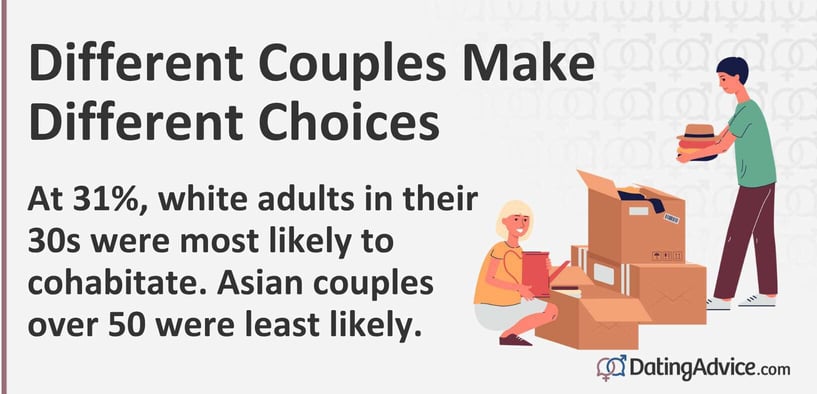
Cultural influences and ethnic identity work together to make a significant difference in the likelihood of an individual cohabitating.
Senior Cohabitation
While it’s less common for seniors to cohabitate than other age groups, it isn’t entirely unheard of. Divorce, spousal death, and personal convictions about marriage can all make cohabitation an appealing option for seniors.
10. In 1968, 0.1% of Baby Boomers Were Unmarried and Living With a Partner
When today’s seniors were in their young adulthood, cohabitation was basically unheard of. In 1968, 0.1% of 18-24-year-olds were cohabitating, compared to 9% today11.
That amounts to 1 in 1,000.
Unlike today’s young adults, who largely marry in their late 20s and early 30s, the young adults of the 1960s were marrying in their early 20s. They didn’t need to cohabitate with their partners to live with them; they would just get married.
The expectation of waiting years for marriage wasn’t there in the way that it is today, and there was a much greater taboo to cohabitation.
11. Only 37% of Adults Over 65 Think Cohabitation Leads to a Better Marriage
Young adults may largely think that cohabitating improves marital outcomes, but that opinion is not shared by their grandparents. According to the Pew Research Center, 37% of adults over 65 think that cohabitation leads to stronger marriages12.
Data shows that cohabitation can negatively affect marriage outcomes in some ways. One major risk factor is moving too quickly to live together due to financial pressure or societal expectations. But then years pass, and they don’t get engaged or married. They’re in relationship purgatory.
Some couples fall into the next relationship stage out of convenience, moving in together to avoid paying rent at two places. Then, as tensions rise and unexpected conflict comes into play, couples have more difficulty uncoupling because their living arrangements and finances are entwined.
12. The Rate of Cohabitating Over 50 Went up to 60 per 1000 in 2019
While younger adults are cohabitating in dramatically higher numbers, older adults seem more apt to cohabitate, too.
Between 2014 and 2019, the rate of cohabitation for unmarried adults over 50 went from 5.2% to 6%13. That’s a small change, but it points to a slow-moving cultural shift from baby boomers to Gen Xers (who started turning 50 in 2015).
13. Only 10% of Unmarried Couples Over 50 Cohabitated in 2022
A survey from Bowling Green State found that of unmarried couples over age 50, just 10% were cohabitating as of 202214.
This low rate of cohabitation might be from long-held traditional beliefs about marriage, sexuality, and wanting to do things the proper way. But it might also be a matter of independence.
Unmarried couples in their 50s and older often have established lives – and perhaps children who live at home. They might be attached to their house or their routine.
Dating can just be fun for seniors; it doesn’t need to have the seriousness of marriage or living together.
Cohabitation Is More Popular at Every Age
Cohabitation isn’t an edgy lifestyle anymore. And it’s not a youth phenomenon. It’s a conventional relationship step that makes sense for all ages.
Couples can make this choice at any age or point in their relationship. It can be the goal on its own or an informative test run before marriage.
If you’re thinking about moving in with your partner, go for it! Just make sure you’re doing it because you’re genuinely excited to live life together, not because it’s the trendy thing to do.
Data Sources:
- https://www.pewresearch.org/short-reads/2019/11/06/key-findings-on-marriage-and-cohabitation-in-the-u-s/ ↩︎
- https://www.census.gov/library/stories/2018/11/cohabitation-is-up-marriage-is-down-for-young-adults.html ↩︎
- https://www.pewresearch.org/short-reads/2019/11/06/key-findings-on-marriage-and-cohabitation-in-the-u-s/ ↩︎
- https://ifstudies.org/reports/whats-the-plan-cohabitation/2023/executive-summary ↩︎
- https://www.bgsu.edu/ncfmr/resources/data/family-profiles/marino-age-variation-cohabitation-2020-fp-22-28.html ↩︎
- https://www.bgsu.edu/ncfmr/resources/data/family-profiles/FP-25-25.html ↩︎
- https://www.bgsu.edu/ncfmr/resources/data/family-profiles/marino-age-variation-cohabitation-2020-fp-22-28.html ↩︎
- https://acpeds.org/cohabitation-effects-of-cohabitation-on-the-men-and-women-involved-part-1-of-2/ ↩︎
- https://www.bgsu.edu/ncfmr/resources/data/family-profiles/decade-of-change-in-cohabitation-across-age-groups-2012-2022-fp-24-03.html ↩︎
- https://www.bgsu.edu/ncfmr/resources/data/family-profiles/marino-age-variation-cohabitation-2020-fp-22-28.html ↩︎
- https://www.census.gov/library/stories/2018/11/cohabitation-is-up-marriage-is-down-for-young-adults.html ↩︎
- https://www.pewresearch.org/short-reads/2019/11/06/key-findings-on-marriage-and-cohabitation-in-the-u-s/ ↩︎
- https://www.bgsu.edu/ncfmr/resources/data/family-profiles/julian-cohabitation-among-unmarried-older-adults-fp-22-10.html ↩︎
- https://www.bgsu.edu/ncfmr/resources/data/family-profiles/marino-age-variation-cohabitation-2020-fp-22-28.html ↩︎