



With the recent Artemis II moonshot mission, the world got excited about space again! It was great to see all the discussions, videos, and memes going around.
There is so much talk about moon bases and Mars missions. But I see one glaring deficiency in the space discussion. I think we’re ignoring one big, important part of life. And that would be the creation of life.
The physical act, the pregnancy, and the implications of sex in space have never been studied to any extent. If we truly want to have star children, we need to look at what that actually entails.
And not just a stupid, sexy coupling like in The Expanse.
The History of Space Sex
NASA has always been squeamish about sex in space. Or rather, the conservative politicians who control the funds have been squeamish.
As of now, there has never been sex in space. Allegedly.
We have so much to learn about, including, but not limited to, the mechanical (how to we physically do it in zero G), female and male reproductive health, psychosocial risks (jealousy, harassment), how hormones react, how different forms of birth control work, how AI can aid in it, and finally how impregnation, gestation, and birth work off world.
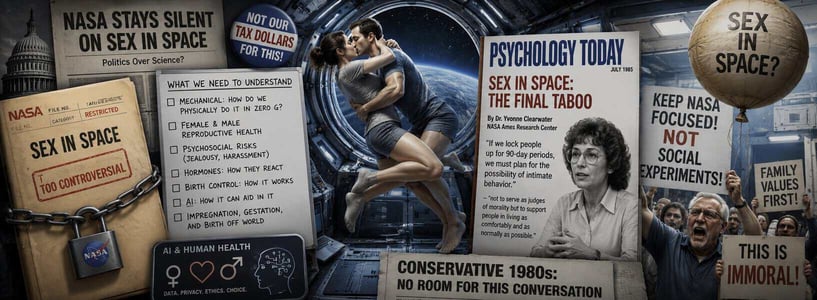
The first real discussion (or lack thereof) came in 1985 when Dr. Yvonne Clearwater, head of habitability research at NASA’s Ames Research Center in Mountain View, California, wrote in the July 1985 issue of Psychology Today.
She said, “If we lock people up for 90-day periods, we must plan for the possibility of intimate behavior.” She added that the scientists were “not to serve as judges of morality but to support people in living as comfortably and as normally as possible.”
Well, because it was the conservative 1980s that went over like a lead balloon.
“If we lock people up for 90-day periods, we must plan for the possibility of intimate behavior.” -Dr. Yvonne Clearwater
Years later, a former colleague of Dr. Clearwater said the article generated much political flak. “I have never seen it hit so hard,” he said. “They had to assign somebody for six months just to deal with Congress. Among other things, it just about killed her career.”
A few articles, including a 1992 New York Times story, popped up over the years, but it basically faded out of mainstream news.
In 2018, researchers Alexander Layendecker and Shawna Pandya submitted a paper called “Logistics of Reproduction in Space,” effectively making their case that this very important area needed lots more attention.
They stated, “If humanity is to ever establish permanent off-world settlements, it becomes critical to understand what the current body of literature says about the safety and feasibility of sexuality, reproduction, gestation, and development in the context of the spaceflight environment.”
Modern-Day Research Continues to Probe This Topic
It would take another five years, but these two researchers would go on to establish the Advanced Spacelife Research Institute (ASRI), the first entity to fully study sex and space.
Their motto is “Quod Liberi Nostri Ut Vivant Inter Astra,” which is Latin for “That Our Children May Live Among the Stars.”
Alex, the director, is a former combat search and rescue pilot as well as a PhD from the Institute for the Advanced Study of Human Sexuality. Shawna is an Astronaut, Aquanaut, Emergency/Aeromedical Transport Physician, Scientist, and Explorer. She is slated to go up soon with Virgin Galactic!
In 2021, Maria Santaguida and Simon Dubé (among others) published “The Case for Space Sexology” and followed it up in 2023 with “Sexual Health in Space: A 5-Year Scoping Review.”
They are now both on the ASRI team as Chiefs of Psychosocial Medicine and Innovation & Development, respectively.
Simon, also a research fellow at the Kinsey Institute of Sexuality, wanted to highlight that “We are going back to the moon to stay and establish a permanent base and communities before pushing toward Mars. And that will require considering the sexual and reproductive health of everyone involved.”
He continued, “Going without sex for 10 days or so [the length of the Artemis 2 mission] may be okay, but when we are talking longer than that, well, it’s not for everyone.”
“Also, we are not just carrying sex into space, we are carrying love.”
In fact, on the last Artemis mission, a crater on the moon was named after Commander Weisman’s late wife, Carroll. “It’s a bright spot on the moon, and we would like to call it Carroll.” Thinking of the future of space involves families and new generations.
The Dark Side of Sexual Relations in Space
Aside from all of the logistical challenges, there’s another, darker side that needs to be studied. Sexual harassment is a real thing in every profession. But, to quote the “Alien” tagline: In space, no one can hear you scream.
There is little to no support for anything inappropriate or harmful that might occur. And there is precedent for such unfortunate cases.

In 1999, Judith Lapierre (also a coauthor of “Space Sexology”) flew to Moscow to work on a Mars simulation experiment. At a New Year’s celebration less than one month after her arrival, she was assaulted by the Russian commander, kissing her and manhandling her.
This happened 10 minutes after a brawl, which was allegedly incited over who would get to talk to her.
Asking for help from her home mission control went nowhere.
According to an article in 2015, “At the end of the mission, Valery Gushchin, the Russian scientific coordinator, claimed that the brawl was a ‘friendly fight’ and that Lapierre had ‘ruined the mission, the atmosphere, by refusing to be kissed.’”
Gushchin’s takeaways were that adding a woman to a men’s crew under the guise of equality was a mistake. He said the expectations are different. “They want to help her, they want to be knights for her that save her…they don’t need one more equal partner.”
Granted, this was 25+ years ago, but it’s not like male-female relationship dynamics have suddenly gotten perfect.
In 2022, the National Science Foundation showed that out of 290 female respondents who stay and work at the United States Antarctic Program, 72% agreed that sexual harassment is a problem. And 47% said sexual assault is an issue they have encountered.
Is sexual harassment a problem in Antarctica?
And it’s not just sexual violence that happens. Actual violence is a thing, too. A somewhat bizarre matter arose in the Antarctic station in 2018. One researcher kept ruining the endings of the books another was reading.
Reaching a snapping point, the latter stabbed the former multiple times in the chest with a kitchen knife, prompting an immediate air rescue to Chile.
Flirting With the Future of Space Sex
ASRI breaks the sex in space research down into 12 separate, but overlapping missions starting next year through 2055 and beyond:
Mammalian Reproduction: Cosmouse, Paniscus, Eileithyia
Female Reproductive Health: Aphrodite
Male Reproductive Health: Hermes
Psychosocial Health: Hera, Psyche
Environmental: Eros, Gaia
Pharmacological: Asclepius
Biotechnological: Hephaestus
Sociocultural: Themis
Their work is important, practical, and ongoing.
Each new mission will bring with it new data that can help refine and inform the next mission.
The crazy thing is that becoming a multi-planet species is now theoretically in our grasp. The next horizon is going to be amazing!