



I’ve spent 30 years learning the marketing tricks that brands use to get attention and make a sale. I believe many of those same strategies and principles can be applied to dating lives to maximize success.
Dating like a brand doesn’t mean being salesy or slick. It’s about showing value and having a strategy that makes sense for your goals.
My dating tips involve knowing what you want and communicating that with clarity and intentionality. Because if you don’t know what you have to offer, your pitch isn’t going to be very convincing.
Here are the five things I wish I’d known about dating sooner.
1. Dating Is an Intent to Own, Not an Intent to Rent
In my opinion, one of the biggest shifts between generations is how we think about ownership. I grew up in the 1980s as part of Generation X.
I owned a cassette tape collection. I kept them in a case, protected them, and replayed them until they eventually cracked. Same with records, cars, even DVDs — when you owned something, you cared for it.
Ownership was early training for commitment and how to take care of something.
Generation Z grew up differently. They stream. Spotify, Netflix, Uber — you don’t own, you rent or subscribe. The upside is convenience. The downside is that it teaches us to dip in and out of experiences without responsibility or permanence.
That mindset has crept into dating. Too many people treat relationships like a streaming service by sampling, skipping, or swiping to the next track. But love isn’t meant to be a playlist you shuffle. It’s meant to be joint ownership where both partners invest, protect, and build something together.
So when I say dating is an intent to own, I mean you approach it with a mindset of care, stewardship, and permanence — not consumption.
2. Know Your DVP (Dating Value Proposition)
Before you look for a partner, you have to know your own brand. In marketing, every brand has a value proposition — which means the unique promise it makes to consumers.
In dating, you need a DVP: a Dating Value Proposition.
I’ve researched philosophy, psychology, and religion, and I challenge anyone to improve on this: every person’s brand rests on four pillars: Mind, Body, Soul, and Resources.
- Mind – intelligence, emotional insight, curiosity
- Body – health, attraction, fitness
- Soul – character, purpose, spiritual alignment
- Resources – stability, ambition, provision
These are the magic four. This is the framework that defines what you bring to the table.
You are your own brand manager. Which pillar is your strongest pillar … aka your X factor? Which pillar has the most opportunity for growth (what most people call weakness, but I call potential)?
If you don’t know your DVP, you’re dating blind. Build your brand first. Then look for a partner who complements it.
3. Unrealistic Standards Can Keep You Single
You cannot ask for everything because you are not everything.
Here’s the trap: everyone wants “everything.” They want Beyoncé’s looks, Plato’s mind, Deepak Chopra’s soul, and Bill Gates’s resources — all wrapped in one person. Forever fantasizing about the billionaire philanthropist who’s also a supermodel, spiritual guide, and Rhodes Scholar.
They don’t exist. On a 1-10 scale, in all four areas of mind, body, soul, and resources, very few people would even get sevens on even two of them.
High-quality relationships are built on prioritization. You need to be clear on your top two pillars you desire and accept that the others won’t be flawless.
It’s not settling, it’s being strategic. Just like you don’t buy a phone expecting it to have the best camera, the longest battery, the sleekest design, and the lowest price, you don’t find a partner who maxes out every category. You pick what matters most for your life.
The sooner you stop chasing “everything,” the sooner you’ll recognize the right “something” when it’s in front of you.
4. Gender Roles Have Changed, so Update Your Playbook
Our grandparents lived by a script: men worked while women managed the home. That playbook is obsolete. Today, women out-earn men in many households. Men are expected to bring emotional depth, not just a paycheck.
And here’s the kicker: it’s not just about gender expectations — it’s also about economics.
The new economic reality is that in most households, it takes two people to figure out which roles they will play. In the past, those roles were more or less a given. Today, they must be negotiated, adapted, and continually revisited.
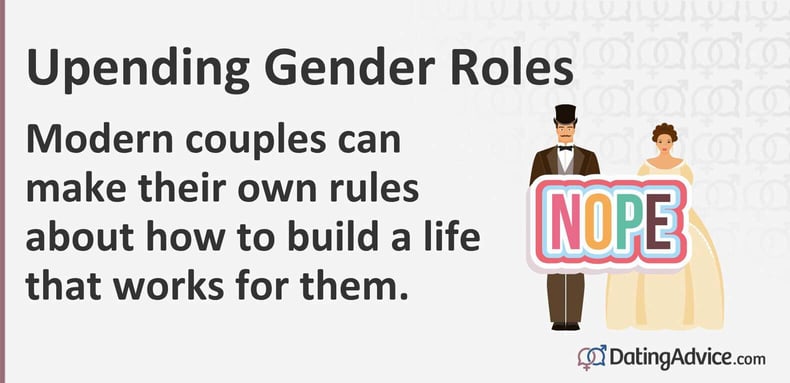
The problem is singles are still operating with outdated expectations. Some women secretly expect men to handle the finances. Some men think “providing” is enough. Both are wrong.
Modern dating requires negotiation, not assumption. Brands constantly adjust to shifting markets, and singles must do the same. Who leads in finances? Who leads in family? Who flexes in career? These are co-written scripts.
Couples thrive when they can adapt — rather than cling to old blueprints.
5. Don’t Get Stuck in a Situationship
The last thing I wish singles knew: It’s not enough to simply avoid situationships — you have to build relationships. And the simplest way to start is the triangle of love.
I have simplified the Psychologist Robert Sternberg’s love triangle down to three elements, think of them as pillars that are required to hold up a high-quality relationship.
The three pillars are Passion, Decision, and Friendship. But if you only have ONE of these pillars, you are simply in one of the three types of SituationSHIPs:
They are:
- PassionSHIP – attraction, desire, spark. If that’s all you have, you’ve got a “bed buddy.” It feels exciting, but without decision or friendship, it fizzles.
- DecisionSHIP – commitment, loyalty, choice. If that’s all you have, you’ve got a “paper partner.” It looks good on the résumé of life, but without passion or friendship, it’s dry and corporate.
- FriendSHIP – trust, companionship, laughter. If that’s all you have, you’ve got a best friend. Great for game night, but not enough to sustain romance or commitment.
Every relationship starts with one of these … and if it eventually is SHIP-WRECKED, it was because one of these couldn’t be completed. You need all three. And when you do, you don’t just have chemistry or convenience — you have a guide to what a high-quality relationship looks like.
The triangle is a solid framework that both people can use to build love together intentionally.
Dating Is Not Random. It’s Strategic
Successful dating requires ownership, clarity of your value, realistic expectations, adaptation to changing roles, and building all three sides of the triangle.
The singles who succeed are the ones who manage love like a brand: they know their proposition, they prioritize smartly, and they pursue partnerships with all three dimensions intact.
Love isn’t magic — it’s management. And when you learn to date like a brand, you can build not just any relationship, but a high-quality partnership that lasts.