


A new dating dealbreaker has entered the mainstream conversation, and it might just be on your list.
Nearly three-fourths (71%) of U.S. households own a pet, making pet owners a clear majority. If you ask a pet owner, most would consider their pets family and maybe even themselves as pet parents. However, some pet lovers are willing to go further in their love for their favorite animals than others, even giving up a chance at true love and romance.
According to our recent DatingAdvice Love, Pets & Partnership Survey, 35% of Americans say they would end a relationship immediately if a partner asked them to give up their pet. Another 22% say they would seriously consider making that decision.
Pets have become a serious force in modern romances, with daters even weighing the idea of a “pet prenup” to maintain custody of their shared pets after a split. So of course, daters aren’t taking pet ultimatums lightly.
Women were more likely than men to say they would end a relationship if a person told them to choose between them or their pet (38% vs. 32%). However, daters are finding ways to avoid these kinds of ultimatums altogether: by dating another pet lover in the same class.
Dog owners showed the most preference for other dog owners, with 68% wanting to date another dog owner, compared with 48% of cat owners who want to date another cat owner. This takes “Are you a dog or cat person?” to a whole new level.
21% of Americans Have Rejected a Romantic Interest Because of a Pet — and Men Are More Likely to Do It Than Women
Pet ultimatums aren’t just hypothetical situations; they’re actually happening in real life. According to our survey, more than 1 in 5 Americans (21%) say they have turned down someone they were genuinely interested in because of that person’s pet.
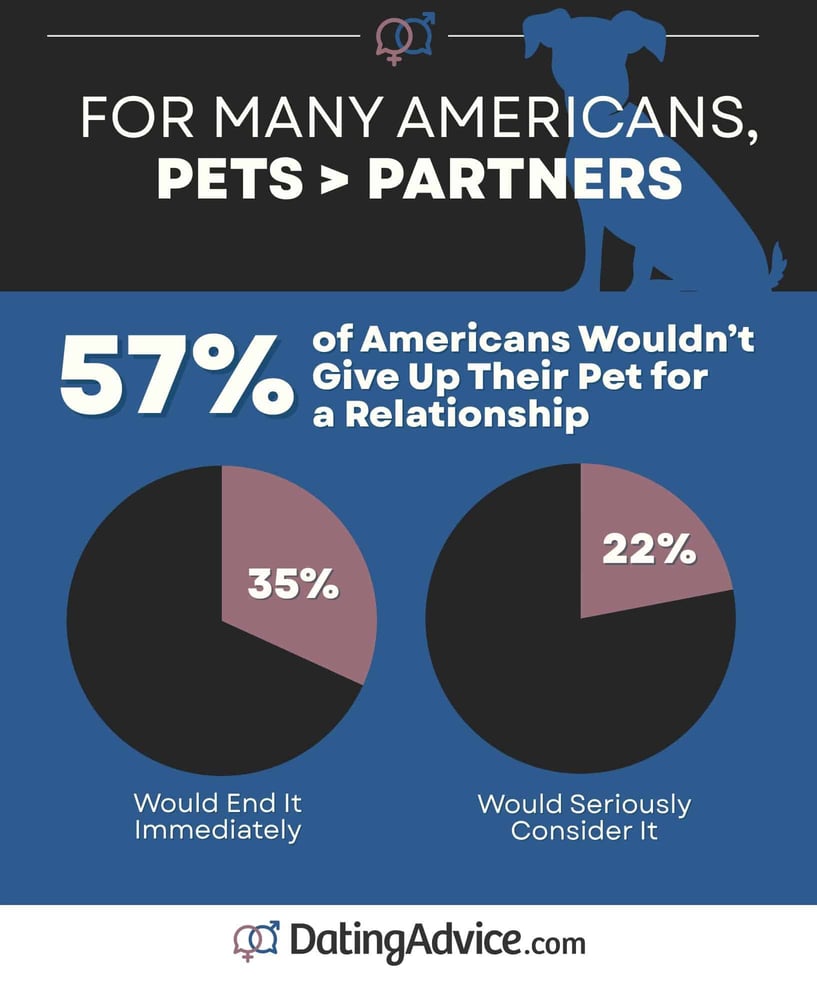
While women are more likely to end a relationship for the sake of their own pets, men are more likely to reject a romantic interest because of that person’s pet (25% vs. 17%).
Across generations, 12% of millennials said they would reject someone based on a dog, compared to nearly 9% of Gen Z and 8% of Gen X.
As for the most devoted pet owners in America, those who own both dogs and cats take the cake. Of those who own both:
- 67% said they would end a relationship or seriously consider ending it rather than give up their pets
- 43% have stayed in a relationship longer than they wanted, specifically to keep access to a pet
- 25% said they’ve broken up with someone because their pet didn’t like the person
Relationship status matters, too. Singles were more likely to prioritize their pets than those in a relationship, with 65% saying they would end or consider ending a relationship if their partner didn’t like their pets.
Surprisingly, 50% of married respondents also said the same, showing that pet relationships can even outweigh long-term commitments like marriage.
2 in 3 Americans Have Changed Their Life for a Partner’s Pet — Cleaning, Scheduling, and Even Allergy Shots
Some may reject a romantic interest because of their pets, but others are more willing to adapt to their partner’s pet. Nearly two-thirds (68%) of Americans confessed to making at least one lifestyle adjustment to accommodate a partner’s pet.
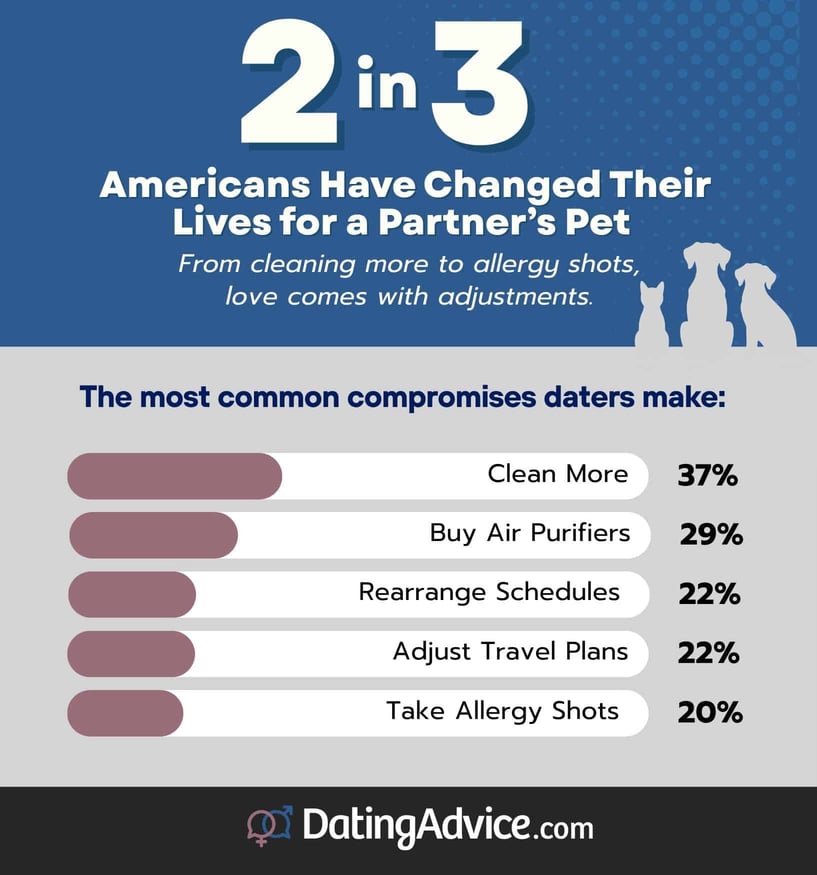
The most common change? Cleaning more often.
Here is a breakdown of the most common changes daters make while dating pet owners:
- 37% clean more often
- 29% bought air purifiers
- 22% rearranged their daily schedule
- 22% adjusted travel or social plans
- 20% took allergy medication or allergy shots
- Only 21% of respondents aren’t open to making any changes
Our study found that daters are making some serious routine adjustments to suit a partner’s pet, including taking medication and rearranging their schedules. But what is love without compromise, right?
It turns out that the Mayor of New York City may be the greatest representation of love and compromise. Mayor Zohran Mamdani admitted to starting an allergy shot regimen so that he and his wife can finally welcome a cat at Gracie Mansion, demonstrating his willingness to make a change for love.
We found notable gender differences among those who made routine changes for pets. Men were more likely than women to adapt in almost every category:
- cleaned or otherwise adapted for a partner’s pet (41% vs. 34%);
- bought air purifiers (32% vs. 25%);
- rearranged their social life (25% vs. 19%)
Generationally, millennials showed the most willingness to adapt to a pet:
- Millennials: 79%
- Gen Z: 75%
- Gen X: 67%
- Boomers: 53%
Pets are just as, if not more, important to daters as their search for love. And it seems the more willing singles are to adapt to a potential partner’s pet, the better it could be for their relationship outcomes.
Pets Are a Part of the Modern Relationship Lifecycle
In every owner’s heart is a special place for their pets, so much so that it can outweigh their place for romance. For many Americans, pets are a relationship priority, a loyalty test, and sometimes a deciding factor in whether a relationship moves forward.
Pets carry a lot of influence in today’s dating culture, and it’s important for daters to weigh how willing they are to adapt to a potential partner’s pet. After all, pets are like family, meaning their bond is irreplaceable.
Methodology
This survey was conducted by DatingAdvice and Prodege and includes responses from 1,498 U.S. adults ages 18 to 79 across a range of relationship statuses, including single, in a relationship, and married. The sample reflects a broad distribution across gender, age, and U.S. regions. Fieldwork was completed in March 2026. The theoretical margin of error for a probability sample of this size is ±2.5 percentage points at the 95% confidence level.
Media inquiries can contact colleen@datingadvice.com.