


You don’t need to be a sociologist to know that marriages are shifting in more ways than one. Gone are the days of getting married right out of high school or college and immediately buying a house.
And maybe, gone are the days of taking it as a given that you’ll get married at all.
So at what age — if at all — are couples hitting these marriage milestones? Let’s get into it!
1. The Average Age for a First Marriage Is 30.5 for American Men
According to one study from Bowling Green State University, the average age of first marriage for men is 30.5 years old1.
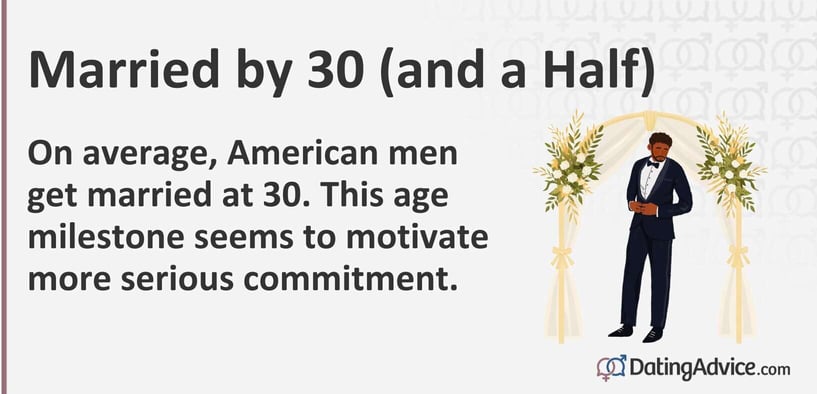
By age 30, most men have established a career, figured out where they want to live, and developed a sense of self outside of their relationships.
Ideally, they’re mature enough to know they’re making the right decision and can feel confident that the love will last2.
2. The Average Age for a First Marriage Is 28.6 for American Women
Interestingly, the average age of first marriage for women is a bit younger: 28.6. In some ways, this actually makes a lot of sense.
It’s common knowledge that women mature mentally faster than men3 and have higher rates of academic achievement than men4. Maybe women are marrying at a younger age because they’re ready for that faster.
At the same time, it also implies that men are more willing — and desiring — of younger women to date and marry. For women in their 30s and 40s who see their male peers continue to go for 23-year-olds, this can be disheartening (cue Hillary Duff singing “Mature”).
3. Since 2008, the Age of First Marriage Has Gone up by About 2.5 Years
The same Bowling Green State University study found that between 2008 and 2022, the average first marriage age increased about 2.5 years (it’s 2.5 years for men and 2.4 years for women, to be precise).
On the one hand, this is a positive. As couples age, they have a clearer sense of what they want in their relationships. They have more time to establish their careers and their identities.
But for singles who actively want to get married, they have to wait longer to find someone ready to make the jump into marriage and become financially stable enough5 that they feel ready to settle down.
4. People Marry Later in Big Cities
Couples might be marrying later, but that doesn’t look the same across the country. Both men and women marry later in Washington D.C., at age 32.5 for men and age 30.7 for women.
Things are a little different in other parts of the country, however. Wyoming men marry at age 27, while Utah women marry at just age 25.3. If you’re having a hard time getting hitched, it might not be the worst idea to head inland.
5. Couples Who Get Married Under Age 20 Are Most Likely to Divorce
Getting married straight out of high school might not be your best bet. One study by the Institute of Family Studies found that a couple who marries at 25 is more than 50% less likely to get divorced than a couple who ties the knot at 206.
The likelihood of divorce kept dropping through couples’ late 20s, though the sharpest changes were in the teens and early 20s.
6. But Couples Over 32 Increase Their Divorce Odds Too
Most people place a lot of emphasis on young couples having a higher likelihood of divorcing, but they often leave out the second half of that fact: So do older couples.
Maybe it just feels more okay to talk down to 20-year-olds than to 40-year-olds. I’d argue we shouldn’t give unsolicited marriage advice to either.
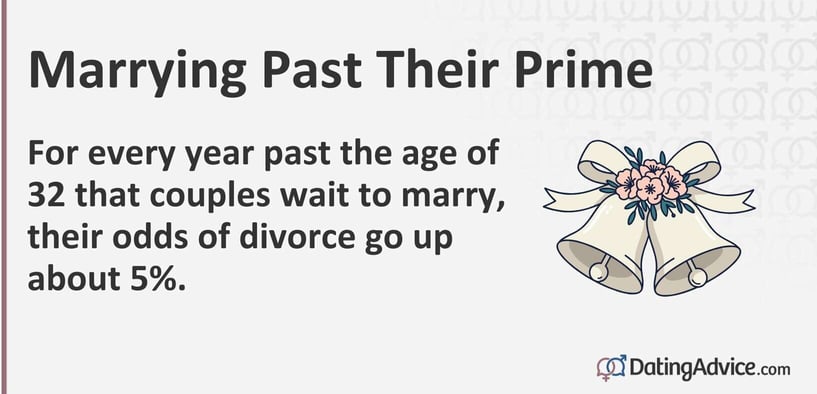
Despite the narrative that marrying younger is a mistake. Odds of divorce actually increase by about 5% for every year over 32 that singles wait to marry7.
If young people struggle to make big decisions about partnership before they know themselves, older singles struggle to compromise their lifestyle to fit a new person into their world.
7. First Marriages Are Less Likely to End in Divorce
Brushing up against the idea that young marriages are less successful is the fact that second marriages have worse odds than first ones. While 40-50% of first marriages still end in divorce8, those odds beat second marriages. Between 60-67% — nearly two-thirds — of second marriages end in divorce.
Some of the reasons for this trend are fairly straightforward. People who have already had a marriage end are more likely to consider divorce in the first place, or may be more attracted to partners who they find themselves in conflict with. They may also be blending families, which complicates relationships.
8. Native-Born Latinas Have the Youngest Median First Marriage Age
There are significant racial and ethnic differences in how we marry. Another study from Bowling Green State University found that the average first marriage age for native-born Latina women was 26.8, the lowest for any racial group9.
Similarly, native-born Latino men had the youngest median marriage age for men at 28.5.
9. More Black Men and Women Marry When They’re Over 30
Of the different racial and ethnic groups, Black men had the oldest age of first marriage overall at 31, while Black women tied with foreign-born Latina women at age 30.6.
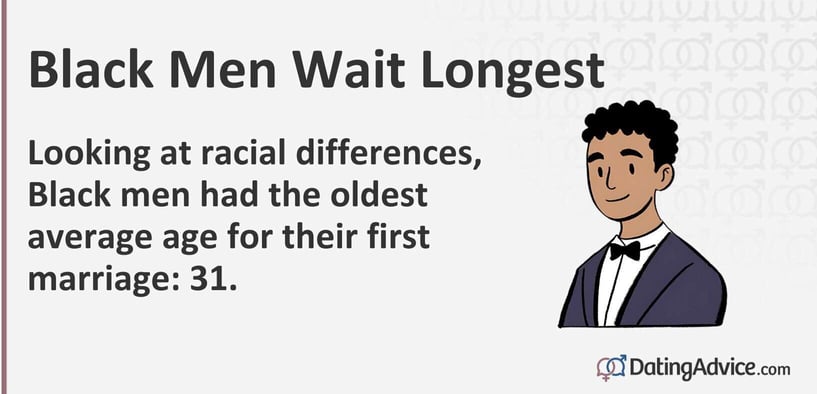
It’s unclear whether racial differences in marriage age come from cultural narratives about marriage, socioeconomic and educational opportunities for different groups, or more likely, a combination of the two.
10. The Higher the Educational Attainment, Add 6 Years to the Average Age of First Marriage
Doctorates take a long time, so it makes a lot of sense that both men and women with doctorates had the highest ages of first marriage: 31.5 for women and 31.6 for men.
That’s pretty different from the average age of marriage for women with less than a high school degree: 25.4.
11. An Estimated 315,000 Minors Were Married in the U.S. Between 2000 and 2021
Many people assume that child weddings are a thing of the past, or that they only occur in developing nations. But Unchained at Last reported that between 2000 and 2021, a staggering 314,154 minors were legally married in the U.S., most (86%) of them were girls10.
I did the math, and it amounts to just under 15,000 teen marriages a year.
The fact that the majority of married children are girls exposes the scariest part of that statistic: Child marriages are not usually a simple case of two 17-year-olds who are so in love they can’t wait until high school graduation to get married. It’s often a teen girl marrying an adult, sometimes one who’s been grooming her.
The U.S. has been making major strides to crack down on child marriage, but it’s still a huge problem.
12. In Every Global Region, Men Marry Later Than Women
Average first marriage ages vary dramatically across the globe, but one thing is consistent no matter where you are: men marry later than women11. That gap can be as small as 2.5 years in Europe, or as big as 5 years in South Asia, but it’s still there.
While age gaps in individual relationships can be perfectly fine, on the global scale, this gendered age divide is depressing. Especially when you consider that the ability to delay parenthood — something that is likely to start after marriage — is a major catalyst for gender equality12.
13. Women Who Marry Younger Have More Children
Reinforcing the issues of the global marital age gap is the fact that women who marry younger have more kids.
According to the World Bank source, “women who marry at the age of 21, on average, have 3.1 births, while women who marry at the age of 25 have 2.4 births.”13
There’s nothing wrong with having more children, and many would argue that we need to be having more children to sustain population growth. But greater access to family planning and choice means that women can gain greater financial freedom and support the children and families they already have.
14. About 22% of 40-Year-Olds Have Never Married
Marriage isn’t for everyone. Pew Research Center found that as of 2022, about 22% of 40-year-olds had never been married. That doesn’t sound crazy, until you compare it to 1980, when just 6% of 40-year-olds had never been married.
The reasons for delaying or even forgoing marriage altogether are vast. Some people find it harder to date in the first place now, feeling unsatisfied with online dating as a replacement for IRL connection. Others simply don’t want to marry, and the increasing social acceptability of that choice empowers them to stay solo.
15. Yet More People Are Marrying for the First Time After 40
Just because more people have never married by 40 doesn’t mean they never will marry. One study found that between 1990 and 2019, the rate of midlife marriages increased 75% for women and 45% for men14.
In 1990, women 40-59 who were marrying for the first time made up just 2% of all first-time brides. Now they’re 9%. Let that be a reminder that you can’t rush love, and that there’s no expiration date on finding your person.
16. Globally, People Think the Ideal Age to Marry Is 25.9
It’s one thing to know what people around the world do; it’s another entirely to know how they think. The Pew Research Center asked people in 18 countries what the best age to marry is15. Answers ranged from just over 21 (Bangladesh) to just under 29 (Argentina).
On average, people thought 25.9 was the right age.
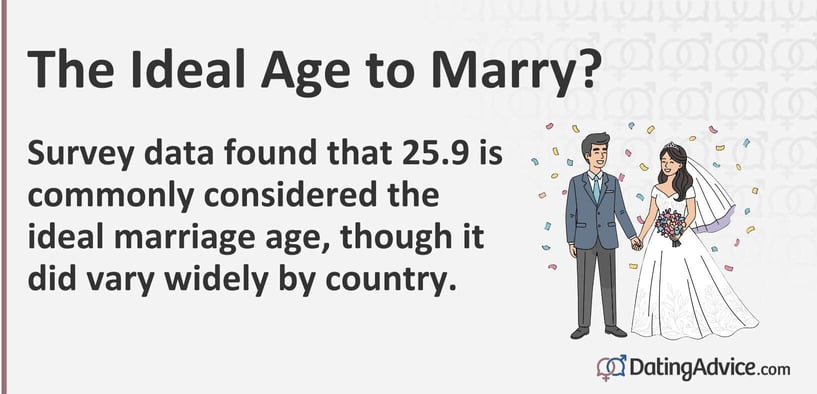
Even within countries, though, opinions varied by gender, education, income, and religiosity. Men, more educated people, higher earners, and less religious people tended to support marrying later, while women, less educated people, lower earners, and more religious people advocated for marrying later.
17. Couples Who Marry Under 25 Might Be Happier
Getting married young might be riskier, but it has some big rewards. One BYU study found that couples who married under 25 had higher sexual and relationship satisfaction than those who waited16.
That being said, these couples also had lower marital stability.
Taken together, it seems that young love might burn brighter…and have a higher risk of going out completely.
18. Men Who Marry Young Experience 5% Worse Conflict Resolution
Both men and women in the BYU study reported higher happiness and sexual satisfaction. But there was one facet of married life where the genders diverged: conflict resolution.
While women who married younger actually reported better conflict resolution than those who married older (77% satisfaction with conflict resolution compared to 79% for those who married later), men found worse conflict resolution after marrying later (53% satisfaction compared to 58%)17.

The biggest gap, however, seems to be the overall difference between the genders. This study found that women were much more likely to be satisfied with conflict resolution overall.
19. 12% of Young Americans Feel a Lot of Pressure to Marry
Most young Americans (73%) don’t feel much pressure from their parents to get married. Whether they stay single or find the one, they know their parents will still be proud of their decisions.
But for 12% of American young adults, the family pressure to marry is real18. They know that marriage is the life path their parents see for them, and getting on it can be a real source of stress.
Marriage can be a wonderful commitment if you want it, but it isn’t for everyone. If your kids seem hesitant to marry, respect their choices. As long as they have loving relationships in their lives, they’ll be alright.
20. People Born Between 1945 and 1954 Have the Highest Rate of Remarrying
Think that divorce is a newfangled trend? Not so. In comparing marriage trends among people born between 1940 and 1979, the Census Bureau found that men born between 1945 and 1949 had the highest rate of being married multiple times (32%), while women born between 1950 and 1954 had the highest rate of their gender (32%)19. Compare that to men born between 1975 and 1979, of which only 12.9% have been married multiple times.
Of course, it’s difficult to do a one-to-one comparison while these groups are at different ages. An eighty-year-old born in 1946 has a higher likelihood of having their spouse pass away compared to a 50-year-old born in 1976, and thus would have more reason and more time to remarry.
21. People Born Between 1940-1959 Who Married Young Were Far More Likely to Remarry
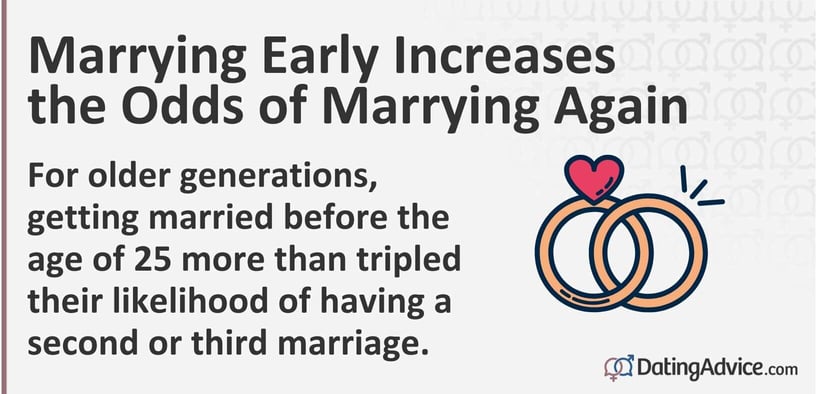
Of women born between 1940 and 1944, about 1 in 4 (or 25.4% to be exact) were married before age 25 and have now been married two or more times.
But, in the same age cohort, only 3.2% of women who married after age 25 have been married two or more times.
The same trend applies for men: 25.9% were married before age 25 and have been married two or more times, while only 8.2% were married after 25 and have been married two or more times. The trend applies for people born over the next 20 years.
When young Americans marry today, it’s generally with the understanding that they don’t need to. Women can get their own credit cards or go on birth control. They don’t have to have children. But for people who married in the mid-twentieth century, there was more cultural pressure to get married with less regard for what they might want out of the future, which makes it less surprising that people who married young weren’t always finding their soulmate the first time.
22. Women Who Worked Full Time 80% of Their Working Years Were Less Likely to Marry
It’s no secret that women are often (though certainly not always) forced to choose between family life and their careers. According to the Bureau of Labor Statistics, women who worked full-time for at least 80% of their years between the ages of 25 and 54 were less likely to get married than those who worked less than that.
Some women take time off work to care for children — that’s more likely to happen for married women whose partners can carry some of the financial load while they stay home.
Meanwhile women who work more hours are more likely to be career-driven and less likely to desire marriage and “settling down.”
23. Researchers Predict that One-Third of 20-Year-Olds Will Never Marry
People are delaying marriage, but an increasing number of people are never entering marriage in the first place. Researchers at the Institute for Family Life only see this trend continuing. Based on census data, researchers predicted that by the year 2050, one-third of 45-year-olds will never have married20.
While no one should marry if they don’t want to, this trend is concerning if many of those unmarried individuals wanted to marry but simply found themselves unable to find suitable partners or see themselves as financially stable enough to enter into a marriage.
24. With 50% of Utahns Married, Utah has the Highest U.S. Marriage Rate
Utah has some of the youngest newlyweds in the nation, with Utah women having the lowest average marriage age. But they also have an overwhelmingly married general population, with nearly 54.9% of adult Utahns married — the highest in the nation21.
This culture of marriage in Utah can be at least partially explained by Utah’s connection to the Church of Jesus Christ of Latter-Day Saints (LDS). About half of Utah’s population is LDS, and the religion places a lot of emphasis on the importance of marriage and a life rooted in family values and connection.
25. New Mexico has the Lowest Marriage Rate in the U.S.
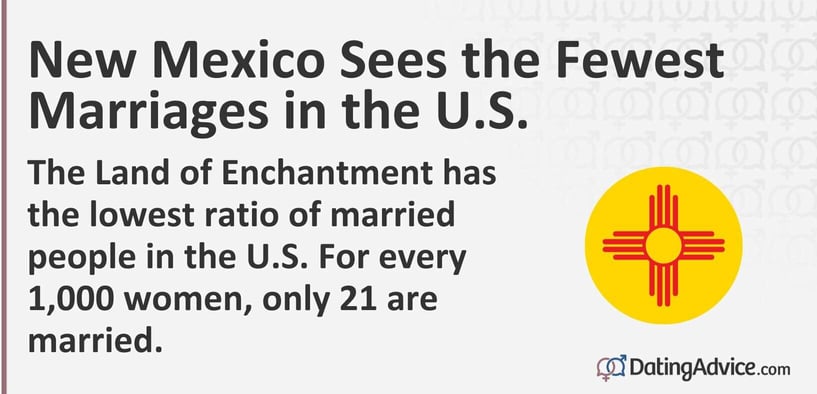
On the other side of the spectrum from Utah is New Mexico, which had the lowest marriage rate in the U.S. — 20.76 marriages per 1000 unmarried women22.
Due to New Mexico’s close proximity to Utah and Colorado — both of which have very high marriage rates — this is surprising.
It’s difficult to find a clear pattern in why states have high and low marriage rates because some of the factors that make people more or less likely to marry are relatively contradictory. Religious people are more likely to marry, as are wealthier and more educated people.
This is why states like New York and Louisiana — states that are seldom next to each other on statistical charts — are right above New Mexico as the states with the lowest marriage rates.
Final Thoughts: Age Isn’t Just a Number
The average age of first marriage is going up in the U.S. and around the world. That has real impacts on life satisfaction, family planning, and economics.
Some of those impacts are for the better, like increased independence for women. Some — like singles’ dissatisfaction with modern dating23 — are not so great.
There isn’t a one-size-fits-all rule on when the best time to marry is. Some people marry their high school sweetheart and truly live happily ever after. Others get divorced when they grow up and grow apart. Waiting to marry until you’re older isn’t foolproof either. Just take your time until you find the person you believe in 100%.
- https://www.bgsu.edu/ncfmr/resources/data/family-profiles/median-age-first-marriage-geographic-variation-2022-fp-24-08.html ↩︎
- https://www.ttsblaw.com/blog/2024/11/why-do-later-marriages-lead-to-a-lower-divorce-rate/ ↩︎
- https://www.psychologytoday.com/us/blog/the-athletes-way/201312/scientists-identify-why-girls-often-mature-faster-boys ↩︎
- https://gap.hks.harvard.edu/mark-womans-record-gender-and-academic-performance-hiring ↩︎
- https://www.rbcwealthmanagement.com/en-us/insights/the-cost-of-marriage-five-money-related-reasons-couples-wait ↩︎
- https://ifstudies.org/blog/want-to-avoid-divorce-wait-to-get-married-but-not-too-long/ ↩︎
- https://www.rabbwilkersonlaw.com/blog/2026/01/does-getting-married-young-really-make-divorce-more-likely/ ↩︎
- https://attorneyraber.com/why-60-of-remarriages-end-in-west-virginia/ ↩︎
- https://www.bgsu.edu/ncfmr/resources/data/family-profiles/julian-median-age-first-marriage-2021-fp-22-15.html ↩︎
- https://www.unchainedatlast.org/united-states-child-marriage-problem-study-findings-through-2021/ ↩︎
- https://blogs.worldbank.org/en/opendata/love-marriage-and-development-4-observations ↩︎
- https://www.who.int/news/item/25-09-2025-contraceptive-use–a-catalyst-for-women-s-health-and-socioeconomic-empowerment ↩︎
- https://blogs.worldbank.org/en/opendata/love-marriage-and-development-4-observations ↩︎
- https://pmc.ncbi.nlm.nih.gov/articles/PMC9616076/ ↩︎
- https://www.pewresearch.org/global/2025/03/19/what-is-the-best-age-to-get-married/ ↩︎
- https://ifstudies.org/blog/capstones-vs-cornerstones-is-marrying-later-always-better ↩︎
- https://ifstudies.org/blog/capstones-vs-cornerstones-is-marrying-later-always-better ↩︎
- https://www.pewresearch.org/short-reads/2024/02/15/among-young-adults-without-children-men-are-more-likely-than-women-to-say-they-want-to-be-parents-someday/ ↩︎
- https://www.census.gov/library/stories/2022/08/does-marrying-younger-mean-marrying-more-often.html ↩︎
- https://ifstudies.org/blog/1-in-3-a-record-share-of-young-adults-will-never-marry ↩︎
- https://gardner.utah.edu/news/utahs-marriage-trends-young-married-and-changing/ ↩︎
- https://www.bgsu.edu/ncfmr/resources/data/family-profiles/loo-marriage-rate-US-geographic-variation-2022-fp-23-23.html ↩︎
- https://www.pewresearch.org/social-trends/2020/08/20/nearly-half-of-u-s-adults-say-dating-has-gotten-harder-for-most-people-in-the-last-10-years/ ↩︎