



Key Takeaways
- While most Americans haven’t gone on a date primarily for free drinks or food, nearly a third admitted to doing so, suggesting this behavior exists at a meaningful level.
- From Gen Z to Boomers, at least 25% in each age group admit to having gone on a “foodie call” — accepting a date only for the free meal.
- Daters in the Western United States — a higher-cost region — were more likely to say they went on a date for a free meal, raising the question of how economic pressures influence “foodie calls.”
If you ask someone what their intentions are during a dinner date, most people would say to get to know a potential match and establish romantic interest. But for some daters, their response may lean a little more toward gastronomy than romance.
According to a new DatingAdvice.com survey, 30% of daters admitted to accepting a romantic dinner invitation just to have a free meal — no romantic attraction involved — revealing a rise in the “foodie call” phenomenon.
While the majority of people say they don’t go on dates primarily for free drinks or food, our study shows a meaningful share let food motivate and shape their dating behavior.
This finding comes at a time when economic pressure is highest among Americans, raising the question of whether this pressure is driving this shift in dating behavior or simply reflecting human nature.
Foodie Calls Aren’t Just for Gen Z — 1 in 4 Adults 65+ Admit They’ve Done It Too
Deviating from the quick coffee dates millennials made popular, Gen Z has been leading the comeback of the traditional dinner date in recent years, according to a Wall Street Journal report. Yet could some of this renewed interest have something to do with nabbing free meals? Perhaps.
According to our data, young people report engaging in foodie calls at significant rates. In fact, 32% of Gen Z and zillennials (ages 28 to 33) say they have gone on a date just to get a free meal, the highest score among any age group.
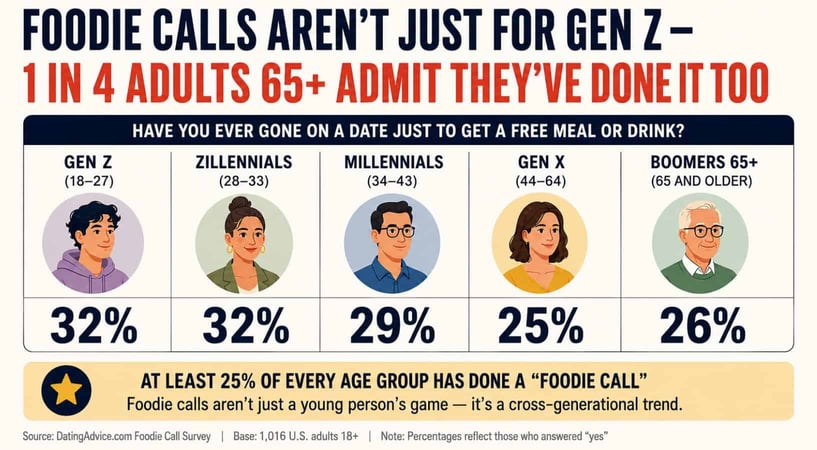
But younger daters aren’t the only ones letting food and drinks influence their dating decisions. Over 1 in 4 adults (26%) age 65 and older also admitted to doing the same. Interestingly, a pattern emerges: At least 25% of every age group says they have done a “foodie call” at least once.
A common misconception is that foodie calls are being fueled by swipe culture and younger generations navigating dating apps. But our data suggests that daters across generations are engaged in this trend at surprisingly similar rates, hinting that foodie calls may be less influenced by generational practices and more by ordinary human behavior.
Daters in the West Are Most Likely to Swipe for Supper — 35% Admit to Foodie Calling
We also found key regional differences among our survey sample. Daters in the Western United States were significantly more likely to agree to a date for a free meal, compared with those in other regions.
Western daters led the pack, with 35% saying they swiped right just for dinner. Southern daters weren’t too far behind in their confession (30%), followed by daters located in the North (26%) and the Midwest (22%).
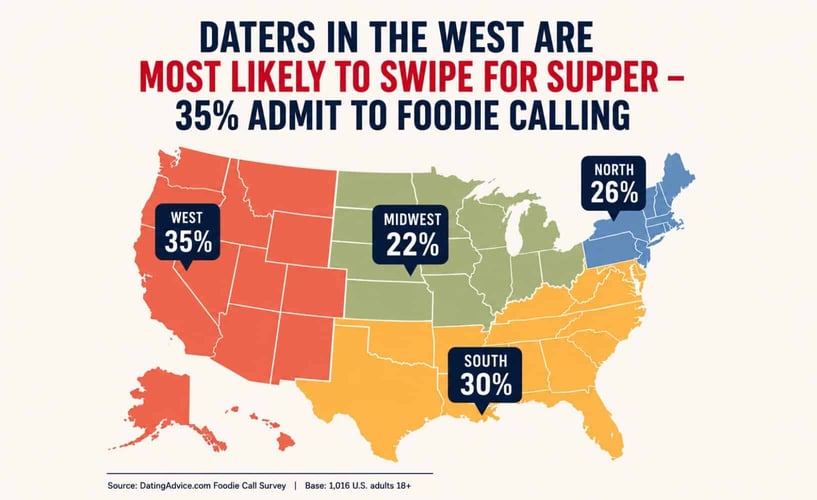
While the Midwest reported the lowest overall number, still more than 1 in 5 daters from the region admitted to the behavior, highlighting the foodie call’s prevalence across the U.S.
Interestingly, we can’t ignore that the West’s leaning toward foodie calls broadly aligns with its economic makeup. Unlike its regional counterparts, the West is known for its high-cost housing and expensive urban centers.
Due to this higher cost of living, people in the West are more likely to face affordability challenges than those in other regions, which may explain their greater inclination to date for free meals or drinks.
While the data can’t formally establish causation, this pattern raises questions about whether economic pressures and regional dating norms influence dating motivations, such as foodie calls.
Going on a date for free food and drinks may not be a new phenomenon in the dating world. But our data reveals just how common it has become within the modern American dating landscape.
As daters continue to navigate evolving dating trends, setting expectations and budgeting may help daters save time and money.
Methodology
This survey was conducted among 1,016 U.S. adults via an online panel. The overall margin of error is approximately ±3.1% at 95% confidence. All questions were single-selection, and each received 1,016 completions. Crosstabs by demographic group (gender, generation, U.S. region, etc.) are available upon request.
Media inquiries, please reach out to colleen@datingadvice.com.