


Nearly half (47%) of surveyed U.S. singles rank honesty as the most important trait in a romantic partner, according to The State of Us: National Study on Modern Love & Dating in 2025, a survey conducted in partnership by DatingAdvice.com and the Kinsey Institute.
Our survey asked 2,000 American singles to select the three most important traits they prioritize in a romantic partner. Honesty outranked physical attraction, financial stability, and sexual competence as the most desirable trait across demographics.
In a time when dating app filters and curated profiles abound, daters are craving authenticity above all else. Online dating and social media often present aesthetics and mask real behavior. But singles are seeking more: partners who can be upfront and genuine while forming connections.
DatingAdvice.com partnered with scientists at the Kinsey Institute to gauge the current dating landscape and uncover what daters value the most when pursuing relationships.
Men and Women See Eye to Eye on Honesty
Is honesty the best policy? For modern daters, the answer is yes. Surprisingly, honesty is just as important a trait in a romantic partner for men as it is for women.
According to our study, male (47%) and female (46%) respondents placed almost equal emphasis on honesty in relationships, ranking it as their top trait.
But what other characteristics do singles value in a potential partner?
When asked to choose their top three relationship traits, our respondents ranked kindness, physical attraction, shared values, and humor as the most important.
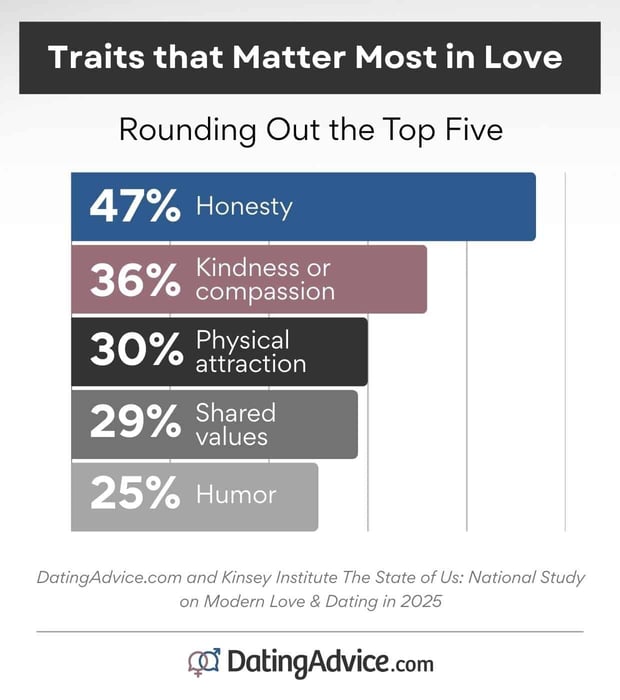
We rounded up the 10 most cited traits. The percentages below indicate the number of people who included each trait among their top three:
- Honesty – 47%
- Kindness or compassion – 36%
- Physical attraction – 30%
- Shared values – 29%
- Humor – 25%
- Dependability or reliability – 23%
- Communication skills – 22%
- Emotional intelligence – 19%
- Similar lifestyle habits – 14%
- Shared religious beliefs – 14%
Financial stability/success (13%), sexual competence (9%), ambition (7%), political alignment (7%), and the ability to handle stress or uncertainty (6%) also received votes.
Surprisingly, traditional markers, such as financial stability, didn’t top the list for the majority of respondents. Qualities such as honesty and compassion ranking highly may suggest a shift in what daters are now seeking in their relationships.
Singles are rewriting the rules of relationships and prioritizing true connection and emotional support over other traits like financial stability. Our results show that character comes first in building the integrity of a relationship for many singles, then everything else.
56% of Gen X and 58% of Boomers Value Honesty but Also Report the Most Cheating
Our study also revealed generational gaps among respondents who value honesty.
We found that older generations were far more likely to value honesty in a romantic partner than younger generations. Gen X and boomers ranked honesty as a top three trait at high rates — 50% and 54%, respectively.
That contrasts with millennials (43%) and Gen Z (36%), who reported lower numbers, but still ranked honesty high.
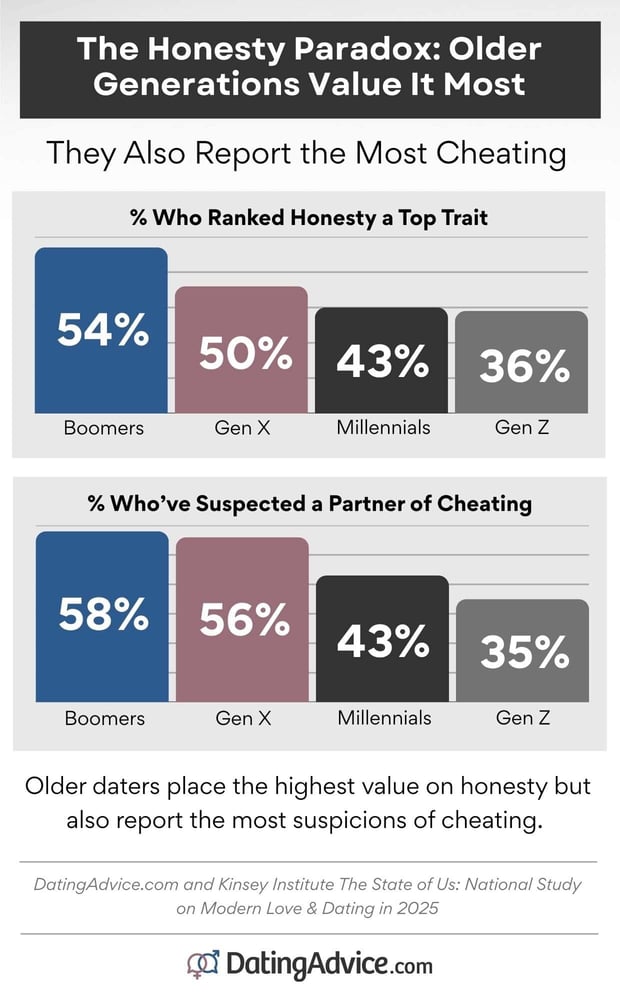
But there may be a reason behind this generational divide. Our study found that Gen X and boomers have a higher likelihood of suspecting a partner of cheating, compared to other generational groups.
When asked if they have ever suspected a partner of cheating, 56% of Gen X and 58% of boomers said yes, while 43% of millennials and 35% of Gen Z reported the same.
Our results suggest that honesty may increase in value as people age. While honesty still remains an important trait for younger adults, they may choose it less due to having less relationship experience and fewer encounters with mistrust.
As people encounter more experiences with dishonesty in their relationships, they are more likely to want to seek out honesty in their future connections.
LGBTQ+ Singles Are 2X More Likely to Rank Political Alignment as Their Most Important Trait
While nearly half of non-LGBTQ+ participants said honesty is a top relationship trait, only 38% of LGBTQ+ singles said the same.
The differences don’t only lie there. Our results show that political alignment is a much more important trait for LGBTQ+ respondents than it is for other singles. While 14% of LGBTQ+ singles believe political alignment is a top relationship trait, only 6% of cis-het individuals thought the same.
“In a time of growing political backlash, differing political views may become a bigger dealbreaker in a community that may feel more vulnerable in a divisive landscape.”
This reflects a potentially stronger political identity or need for values alignment within the LGBTQ+ community. In a time of growing political backlash, differing political views may become a bigger dealbreaker in a community that may feel more vulnerable in a divisive landscape.
Unsurprisingly, cis-het and LGBTQ+ groups also differed on religion. Non-LGBTQ+ participants were more likely to rank shared religious beliefs as important than LGBTQ+ participants, indicating religion plays a smaller role for LGBTQ+ singles.
Emotional intelligence was another trait that topped the list for the LGBTQ+ community. Ranking it at 4th, compared to 8th for cis-het groups, 28% of LGBTQ+ surveyed singles view emotional intelligence as a must-have in romantic partners, versus 18% of cis-het singles.
Our study reveals that while LGBTQ+ and non-LGBTQ+ groups agree that honesty and kindness are top priorities, that’s where their shared consensus ends.
LGBTQ+ singles value politics, shared values, and emotional intelligence more, and cis-het singles emphasize physical attraction, dependability, and religion.
We can’t deny that honesty has become a standard in the modern dating playbook. And singles from all backgrounds can agree that it is an essential trait when seeking a romantic relationship.
In dating, honesty isn’t an exception but the key to forming serious connections in an era when singles are craving authenticity more than ever.
Methodology
The State of Us: National Study on Modern Love & Dating in 2025 was conducted by DatingAdvice.com and the Kinsey Institute, led by Dr. Justin Lehmiller and Dr. Amanda Gesselman.
Data was collected by Prodege.com among a nationally representative sample of 2,000 single U.S. adults ages 18 to 91 via an online survey from April 29 to May 8, 2025. The sample was balanced for age, gender, household income, geographic region, and race/ethnicity. Margin of error: ±3 percentage points at the 95% confidence level.
Media inquiries, please contact colleen@datingadvice.com.