


Key Takeaways
- Nearly half (49%) of surveyed U.S. adults say they have left a date due to bad behavior, compared to 26% who say they ended the date because of misleading photos.
- Parents with young children have the lowest tolerance for bad date behavior, with 65% of those surveyed saying they walked out on a bad date.
- 1 in 10 adults stayed through the date but blocked or deleted the person’s contact immediately afterward.
A first date often feels like a high-pressure environment for forming initial impressions. Whether you end up liking your date or not, most people want to keep the encounter polite and friendly.
But what if your date is nothing like the person you met online — looks-wise or behavior-wise? Do singles still have to stay on a bad date just to be polite?
A new DatingAdvice.com survey examines this familiar dating dilemma, including how often Americans actually leave dates early, what causes them to walk out, and who is least willing to stay when a date goes sideways.
And the results reveal that singles are putting pleasantries aside and prioritizing their time when it comes to bad dates.
Nearly Half of Americans Have Walked Out Because of Bad Behavior
Interestingly, bad behavior is the most common reason for ditching a date early among singles surveyed.
Nearly half (49%) of surveyed Americans say they have left a date early due to a date’s bad behavior, compared to only 26% who say misleading photos were the reason they left.
These results were virtually identical across genders, challenging the assumption that women may be more likely to stay on an uncomfortable date because of politeness or safety concerns. Here is how both genders responded to both misleading photos and bad behavior:
- 48.8% of men and 49.2% of women have left because a date behaved badly.
- 26.7% of men and 26.2% of women have left because someone looked different than expected.
What causes singles to walk out on dates has less to do with looks and more to do with respect. Our study shows that behavior is the biggest disconnect among singles as they navigate online dating, suggesting that a connection made online may not always translate in real life.
65% of Parents With Young Kids Have Walked Out on a Bad Date
While some may stick through a date despite feeling uneasy, others are reclaiming their time and leaving bad dates early. And those who are most willing to walk away? Parents with young children.
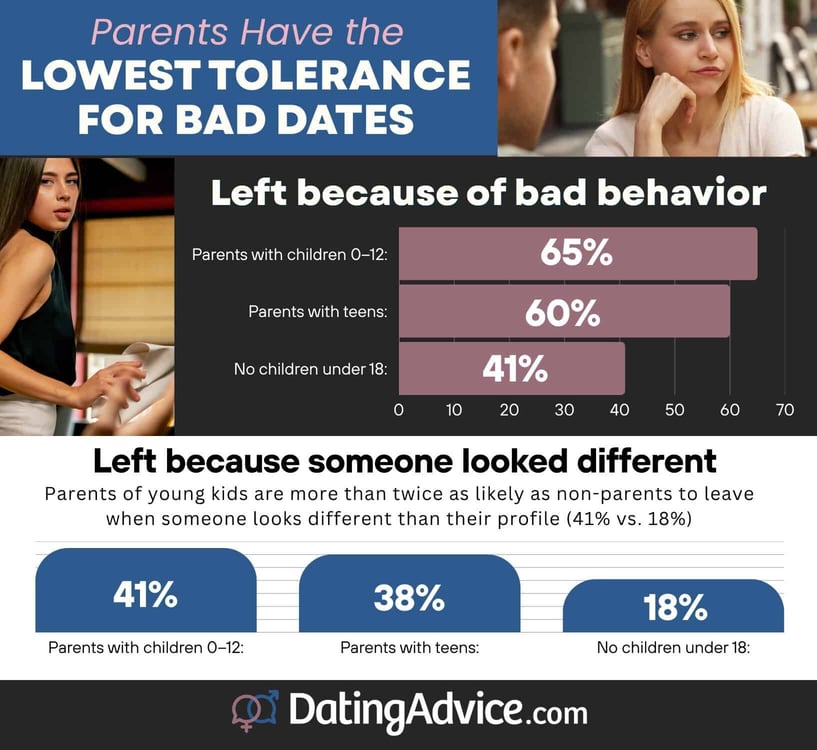
When asked whether they would leave a date early because of bad behavior, here is how those with and without children responded:
- Parents with children ages 0–12: 65%
- Parents with teenagers: 60%
- Adults without children under 18: 41%
As for leaving early due to misleading photos, here are the responses:
- Parents with children ages 0–12: 41%
- Parents with teenagers: 38%
- Adults without children under 18: 18%
Parents with young children led in walking away from both misleading photos and bad behavior, making them the least tolerant group of these dating faux pas.
In reality, parents, especially those with young children, probably have the least time to waste. Limited free time and childcare responsibilities may make parents less willing to spend an evening on a date that has already gone wrong.
More Than 1 in 4 Adults Under Age 35 Have Walked Out Over Misleading Photos
Young adults were the most likely to walk away from a date early due to the person not resembling their dating profile photos. More than 1 in 4 (29%) adults under age 35 say they have left a date over misleading photos, beating the national average of 26%.
Younger people may feel more comfortable walking away because of their familiarity with the online dating landscape. Unlike older adults, younger people are more likely to use dating apps and understand the expectations set by online dating profiles, which may explain why they are less tolerant of misleading photos.
1 in 10 Stayed Through the Date — Then Cut Off Contact
While over half (51%) of people surveyed said they stayed for the remainder of the date, some didn’t stick around for long after. One in 10 adults who stayed even though their date looked differently than expected said they blocked or deleted their date’s contact immediately after the date.
Women edged out men slightly in cutting off contact, with 10.1% of women doing so compared with 8.3% of men.
Our results show that staying through a bad date doesn’t necessarily mean someone is willing to overlook the deception or offer a second chance. Some daters may feel safer or more comfortable finishing the interaction before cutting off contact afterward — another way to protect their time and prioritize connections built on honesty.
Methodology
This survey was conducted among 1,016 U.S. adults via an online panel. The overall margin of error is approximately ±3.1% at a 95% confidence level. All questions were single-selection, and each received 1,016 completions. Crosstabs by demographic group, including gender, generation, and U.S. region, are available upon request.
Media inquiries, please contact colleen@datingadvice.com.