



When it comes to cohabitating before marriage, everyone has a different opinion. Some – particularly younger people – feel like marrying a person you haven’t seen scrub their toilet is bananas. Others take moral issue with living together prior to tying the knot.
As a cohabitant living with my (now) fiancé, I certainly have a personal stake in the matter. But I’m more interested in facts than opinions.
These marriage and cohabitation statistics shed light on how American adults feel about cohabitation and how cohabitation actually affects long-term relationship success.
1. Since the 1990s, the U.S. Marriage Rate Has Dropped to 46.4%
People are not getting married nearly as often as they used to. And because Americans also tend to marry later, they spend a larger chunk of their lives as unmarried individuals.
One study found that in 1996, 55.9% of American adults were married, compared to 46.4% in 20231. That’s a 9.5% drop, and applied to the population, that means tens of millions fewer people were married in 2023 compared to 1996.
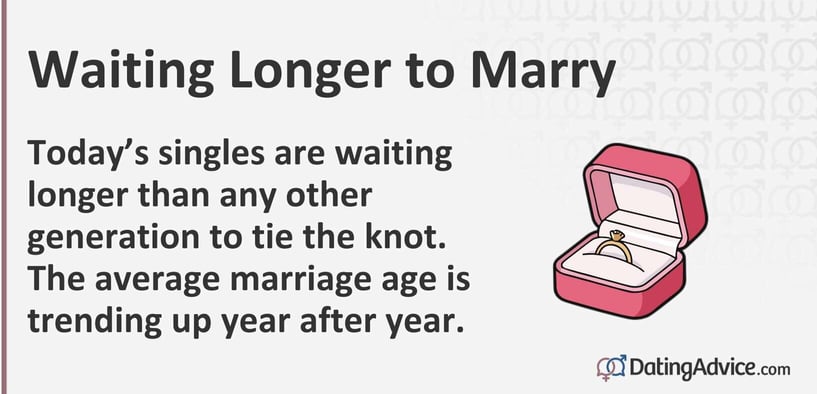
Plenty of factors pull individuals away from marriage. Women’s financial independence means they don’t rely on marriage to have a stable future, so they can be more choosy. Societal pressure to marry has also lifted to a certain extent.
Many people are forgoing relationships altogether, preferring to stay single or finding it difficult to meet a suitable partner.
The fact is that fewer adults find marriage a desirable institution to enter.
2. While Cohabitating Rates Have More Than Doubled
Most unmarried couples still want the lifestyle that historically has gone with marriage; they’re just doing it on their own terms.
While marriages have gone down, the cohabitation rate has shot up from 3.7% of individuals cohabitating in 1996 to 9.1% cohabitating in 20232. That 5.4% increase doesn’t entirely explain the drop in marriages, but it’s good context to know.
Plenty of today’s cohabitating couples likely would’ve been married in 1996 – and may very well be married in a few years.
In the 1990s, cohabitating wasn’t quite as socially acceptable as it is in the 2020s. Today, couples see cohabitation as a valid step in their relationship, sometimes as a test ground for marriage, or sometimes for its own sake.
3. At 10.1%, High School Grads Are Most Likely to Cohabitate
Generally speaking, those with lower educational attainment are more likely to cohabitate. A survey found 10.1% of individuals whose highest level of education was high school graduation cohabitate, compared to 6.2% of those who have completed some level of graduate degree3.
This may come down to class difference. Marriage is more common for those with higher education levels and higher incomes. But it’s also a matter of age, with many people pursuing higher education, cohabitating, and marrying later on.
I moved in with my fiancé after I received my bachelor’s degree; shortly after our wedding, I’ll graduate from my master’s program. I will have cohabitated as a person with lower educational attainment relative to my educational level following marriage.
4. Before Marriage, 70% of Couples Live Together
While not everyone assumes they’ll marry their live-in partners, most couples see cohabitation as a necessary step before they get married.
According to the Institute for Family Studies, 70% of couples live together before they get married4. Once seen as rather scandalous, living together before marriage is now widely accepted as a prudent and obvious choice.
When a couple moves in together matters. Some find it important to cohabitate together only after engagement, while others want to live together out of convenience while dating.
And while couples who move in only after marriage are increasingly a minority, they do exist. Many traditional individuals find it important to stay separate until vows have been exchanged.
5. Up to 65% of Americans Believe Cohabitating Before Marriage Is a Good Idea
Before my fiancé and I moved in together, I was concerned that we’d be judged by older people in our lives. I don’t know what everyone thought about it, but no one gave us a hard time.
In fact, IFS reports that between 50-65% of Americans believe that cohabitating prior to marriage sets the relationship up for success5.
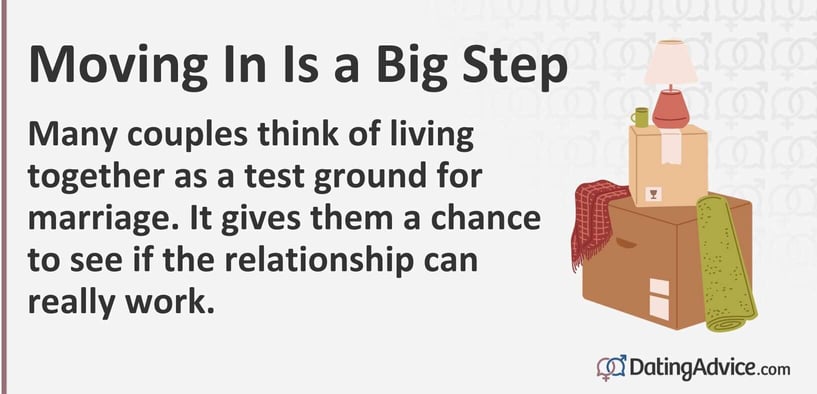
The benefits of living together prior to marriage are pretty clear. So much of what goes into building a life with a partner is the mundane habits and chores: Cleaning, cooking, bedtimes, hobbies. Living with a person can give you a pretty solid sense of what life together is like.
Anyone who’s had a roommate disagreement knows: Living together can make or break your relationship. Most couples would like that to happen before a marriage is official.
6. Couples Who Cohabitated Before Engagement Were 48% More Likely to Divorce
Given all the positives of living together, it may come as a surprise that couples who cohabitated prior to engagement were actually 48% more likely to divorce than those who waited6.
Taken by itself, cohabitation seems to have a negative effect on relationship outcomes.
But I’d like to add some context to this statistic. People who cohabitate are likely less traditional and less religious than those who don’t. Cohabitators may be more open to divorce than those who wait to live together.
On the other hand, it’s possible that cohabitation creates conflict in the relationship early on – whether over marriage itself or other issues best solved independently – that build cracks that undermine the marriage.
7. Among Married Couples, 18.7% of Those Cohabitating First Suggested Divorce at Some Point
Marriages between cohabitators aren’t just more likely to end; they’re also more likely to be turbulent.
One study found that 18.7% of married couples who had cohabitated before marriage had discussed divorce at some point, compared to just 10.2% of married couples who didn’t cohabitate prior to marriage7.
This backs up my theory that cohabitating couples are more open to divorce in the first place. Therefore, they’d be more likely to bring it up than a conservative Christian couple who consider divorce a sin.
But there’s also the possibility that, on average, couples who put off commitment and live together are messier and more prone to fighting than those who go straight into marriage.
8. Two-Thirds Say It’s Always Acceptable for Unmarried Couples to Live Together
The overwhelming majority of Americans think it’s fine for any unmarried couple to live together.
According to the Pew Research Center, 69% of Americans think it is acceptable for unmarried adult partners to live together even if they don’t plan to marry, while an additional 16% think it’s acceptable if they do plan to marry8.
While living together as an unmarried couple was once seen as promiscuous, most Americans understand that living together is actually a very serious step in a relationship.
And given that more than 90% of Americans had premarital sex, most people’s opposition to cohabitation on the grounds of increased sexuality has gone out the window9. With the exception of the devoutly religious, it’s assumed that adult couples are having sex, regardless of whether they live together.
9. At 53%, Most Think It’s Better If Serious Couples Eventually Marry
Many Americans think it’s fine for couples to cohabitate without marrying, but they also want these couples to marry eventually. Pew Research Center found that 53% of Americans think that society is better off when long-term couples get married, instead of simply cohabitating indefinitely10.
Cohabitation has many of the perks of marriage, but most Americans feel the institution of marriage is superior.
It’s easy to break a lease with an ex-girlfriend; it’s harder to casually get a divorce. Marriage is a serious institution that makes couples approach relationships with commitment at the forefront.
Additionally, marriage comes with many legal protections – not to mention tax benefits – that shouldn’t be taken lightly. There’s a reason why the right to marry is worth fighting for: Marriage has real implications and benefits for spouses.
10. Cohabitators Are 3X More Likely to Say They Moved in Together Because of Financials
Some cohabitation-based relationships happen as an economic convenience. At 38%, cohabitators are three times more likely than married couples to say they entered their relationship step due to the financials (13% of married individuals)11.
Moving in together out of financial concerns is one possible reason cohabitation is more likely to result in divorces and toxic relationships. Perhaps one partner has a lease end and is debating looking for a new place. They could cut costs by sharing rent with their partner, whose house they’re sleeping at a few nights a week, anyway.
While this sounds like an obvious reason to move in together, it can be a bad idea to take a step in your relationship because of outside factors. Suddenly, you find yourself marrying for tax purposes and staying in a relationship that was always more practical than loving.
This isn’t to say you can’t make housing decisions that make sense for your financial situation, but it shouldn’t be the primary motivator.
11. Half of College-Educated Cohabitators See It as a Step Toward Marriage
There’s a big difference in rates of cohabitation among different income levels, but there’s also a difference in the mindset between the wealthy and the poor. About 50% of college-educated cohabitators see it as a step toward marriage. That’s far more than the 28% of cohabitators with a high school education or less who see it as a step toward marriage12.
For educated individuals – who already have a high expectation of marriage – cohabitation is a practical step to see if marriage is feasible.
Less educated individuals may not expect to marry at all, or they may be more likely to move in together out of financial pressure.
12. A Majority (56%) Cite Being Financially Unprepared as a Reason for Delaying Marriage
Marriage isn’t just a piece of paper. It comes with many expectations about what married life should look like, and for many unmarried people, that often looks like financial stability.
A solid 56% of cohabitators cite their lack of financial preparedness as a reason they aren’t engaged or married13. And 53% cite their partner’s lack of financial stability as a reason.

Sometimes, that lack of financial preparedness means extreme debt or bad credit. Other times, it’s as simple as saving up enough to have a nice wedding.
For cohabitators, living together means the emotional pressure to marry quickly might not be as strong, so it’s easier to put off the actual wedding date due to financial concerns.
13. The Median Woman Who Didn’t Cohabitate Prior to Marriage Is 26
Couples who cohabitate get married on different timelines than those who don’t live together first. Bowling Green State University found that the median woman who did not cohabitate prior to marriage got married at 2614.
The median woman who did cohabitate got married at age 27.
The data points to non-cohabitators getting married a year earlier. Which is significant.
Those who don’t believe in cohabitation may come from cultures where marrying younger is more normalized. They may also expect marriage and family on a tighter timeline.
And because they spend less of their adult life unmarried, cohabitation may not be relevant in their relationships.
14. For Older Millennials, Only 6% of Cohabitations Last 10+ Years
Even if cohabitating feels similar to marriage, it’s different in one major way: The lack of permanency.
Cohabitation can go in two possible directions. They either turn into marriages or end in breakups. Seldom do cohabitations last indefinitely. Among adults born in the 1980s, only 6% of unmarried cohabitations make it past the 10-year mark15.
This isn’t to say that cohabitations are unsuccessful because they don’t last forever. For cohabitators who don’t want to marry, the impermanence may be part of the appeal.
Cohabitators get to be with their partner while the love lasts and move on when things run their course. And if one partner is hoping for the other to change their mind on marriage, they’re not likely to wait around more than 10 years!
But it’s safe to say that marriage does add an expectation of commitment, and when that’s deliberately skipped, couples are unlikely to stick it out.
There Isn’t One Formula for Relationship Success
No one relationship path works for everyone. It varies for everyone. Married couples and cohabitating couples alike can enjoy happy, fulfilling relationships.
I’d say the effort and expectations you have going into a relationship matter a lot more than when you sign a lease together.
If you’re entering a cohabitating living arrangement, make sure you’re doing it out of love and commitment, not just convenience. Apply the same level of seriousness you’d bring to a decision to marry, even if that isn’t your goal.
Data Sources:
- https://budgetmodel.wharton.upenn.edu/p/2025-02-18-change-in-american-families-favoring-cohabitation-over-marriage/ ↩︎
- https://budgetmodel.wharton.upenn.edu/p/2025-02-18-change-in-american-families-favoring-cohabitation-over-marriage/ ↩︎
- https://budgetmodel.wharton.upenn.edu/p/2025-02-18-change-in-american-families-favoring-cohabitation-over-marriage/ ↩︎
- https://ifstudies.org/blog/cohabitation-is-popular-but-its-still-no-replacement-for-marriage ↩︎
- https://ifstudies.org/reports/whats-the-plan-cohabitation/2023/executive-summary ↩︎
- https://ifstudies.org/reports/whats-the-plan-cohabitation/2023/executive-summary ↩︎
- https://pmc.ncbi.nlm.nih.gov/articles/PMC5956907/#S9 ↩︎
- https://www.pewresearch.org/social-trends/2019/11/06/marriage-and-cohabitation-in-the-u-s/ ↩︎
- https://pmc.ncbi.nlm.nih.gov/articles/PMC10989935/ ↩︎
- https://www.pewresearch.org/social-trends/2019/11/06/marriage-and-cohabitation-in-the-u-s/ ↩︎
- https://www.pewresearch.org/social-trends/2019/11/06/marriage-and-cohabitation-in-the-u-s/ ↩︎
- https://www.pewresearch.org/social-trends/2019/11/06/marriage-and-cohabitation-in-the-u-s/ ↩︎
- https://www.pewresearch.org/social-trends/2019/11/06/marriage-and-cohabitation-in-the-u-s/ ↩︎
- https://www.bgsu.edu/ncfmr/resources/data/family-profiles/FP-25-25.html ↩︎
- https://ifstudies.org/blog/cohabitation-is-popular-but-its-still-no-replacement-for-marriage ↩︎