


Safety always plays a crucial role in relationship success, but it’s especially important to daters over 55, according to DatingAdvice’s new survey.
And perhaps surprisingly, late middle-aged and older daters are using technology to confirm their safety: nearly 4 in 10 respondents aged 65+ have searched online for a date’s criminal or court records.
Daters aged 55-64, who we consider to be late middle-aged, and daters over 65, who we refer to as “older” in this study, bring a lifetime’s worth of love and loss to their relationships. By this time in their lives, they don’t want surprises — and they don’t want to waste time on people who don’t share their values.
These daters want to know what to expect from the jump, which means they want to access information about a potential date’s life that they otherwise wouldn’t see. This includes a criminal background, yes, but also net worth, income, and whatever else a general background check can dig up.
And if these background checks dig up anything juicy? They can easily be the difference between a first date and a canceled date, according to respondents.
This study reveals a growing group of late middle-aged and older Americans who want to balance practical needs, like financial security, with emotional needs, like shared values or certain personality traits. These daters’ needs change the way they date, and sheds light on how the dating industry can best serve them.
Safety Matters More Than Salary to Daters Over 55
Online dating is not solely a young person’s game, but you have to admit: it isn’t exactly built for people who remember when the Berlin Wall fell. And with 11 million Americans over the age of 50 telling AARP that they’ve been drawn into a romance scam, online safety has become a #1 priority… perhaps even more so than finances.
One of the most surprising revelations from this study is how late middle-aged and older Americans have embraced the benefits of Google while online dating.
0% of respondents aged 65+ have searched for a potential date’s criminal or court records
Among adults 65+, 39% have searched for a potential date’s criminal or court records, and 6% of these respondents have canceled a date as a result of what they found (vs. 37% and 2%, respectively, for late middle-aged daters).
It’s not that these daters are less trusting, but that they value simple, straight-forward ways to confirm a date’s trustworthiness.
And when it comes to safety vs. salary, late middle-aged and older daters would rather know they’re going on a date with an upstanding member of the community than with a rich one: Only 17% of adults 65+ searched for salary or salary-range information, and just 18% of adults ages 55–64 did the same.
Of respondents 65+, 0% searched those records and subsequently canceled the date.
These daters are twice as likely to research a date’s criminal history over their salary. Money is still a vital part of these daters’ futures (and their safety), and financial compatibility is still important to them. But safety seems to be at the top of their list — not least because it’s usually easier to access criminal records than financial records.
Late middle-aged and older Americans’ high safety standards reveal a generation in the midst of an evolution: They’re willing to embrace complicated technological innovations if doing so means their safety needs are met.
45% of Adults 55+ Have Walked Out on a Rude Date
As important as safety is to daters over 55, personality is just as important. These adults aren’t so quick to tolerate bad behavior from a date. Case in point: nearly half (45%) of adults over 55 have simply walked out on a date because they felt the other person was being rude.
You know that saying, “When people tell you who they are, believe them?” This is what many daters 55+ seem to live by. They believe the way someone treats service workers, like restaurant servers, reveals more about their character than a dating profile ever could.
Young people sometimes take common courtesy for granted, but late middle-aged and older adults see it as a behavioral baseline. In other words, they don’t endure discomfort or bad behavior the way younger people tend to do. No awkward cocktail-stirring and stilted conversations for them.
This older generation of daters don’t only know what they want, but what they don’t want — and they aren’t afraid to express these needs in the moment. Respect and basic courtesy are the bare minimum. If someone crosses these boundaries, it sends a strong message to daters 55+: “I can’t be trusted.”
When a Date Looks Different From Their Profile, 36% Cut Ties
For younger daters, catfish have become something of an occupational hazard — an eventuality of modern-day dating. But daters 55+ are a different story. The identical survey responses of daters in the late middle-aged group and in the 65+ group reveal just how highly they value honesty from the very first “like” on a dating site.
Case in point: 36% of each late middle-aged and older group said they would reject someone for looking differently than expected.
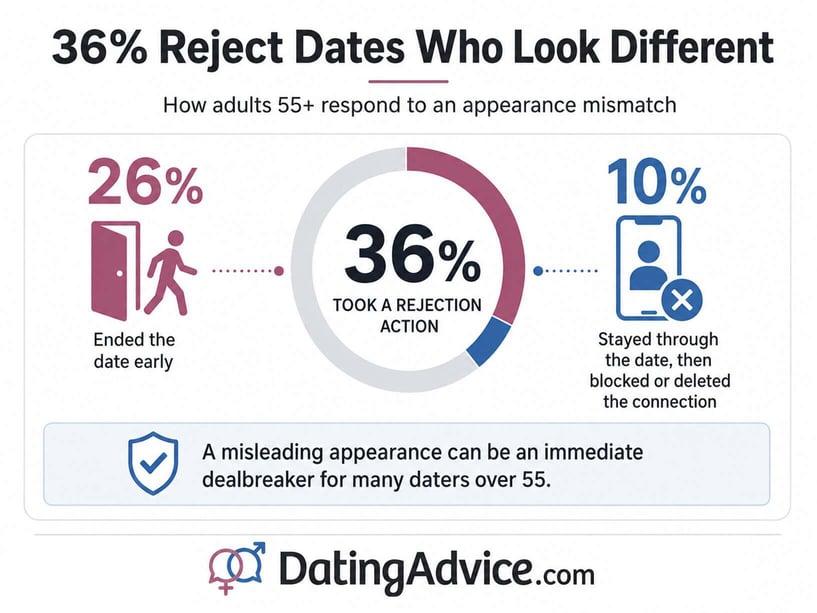
Many late middle-aged and older people agree that catfish are a modern dealbreaker. Although they probably won’t expose the person on a certain MTV show, 26% would leave early if their date doesn’t resemble their profile pic.
And even though 10% of respondents from both age groups said they’ve stayed on the date, they also said they deleted or blocked the connection afterward.
Even seemingly minor discrepancies, like when a date is balder than advertised or a slightly different age, may be enough for a 55+ year old dater to pull the plug. This is not based on superficiality, but on basic transparency — or a lack thereof.
It’s important to consider the high percentage of daters who seemingly don’t feel comfortable, or are unwilling to, cut off potential catfish.
It’s encouraging that 36% of each 55+ age group is willing to cut off a potential catfish. But it’s important to consider the higher percentage of daters who seemingly don’t feel comfortable, or are unwilling to, cut off potential catfish.
It’s possible that someone not looking like their profile pic simply isn’t a dealbreaker to these daters. But this study might reveal a potential area of need for daters 55+. Has the dating industry done enough to educate late middle-aged and older adults about the potential dangers of online dating?
The growing danger of romance scams, as well as late middle-aged and older daters’ desire for honesty, suggest that safety will continue to define successful modern dating — and it will continue to be the industry’s responsibility to provide it.
1 in 4 Older Adults Admit to Dating for a Free Meal
In a relatable twist, 26% of respondents aged 65+ have gone on a date primarily for the free food and drinks; 25% of adults aged 55-64 said the same. It’s what the kids call a “foodie call,” but judging from this study, it’s not just a young person’s habit.
Overall, 30% of surveyed adults over 55 admitted to participating in a foodie call.
This isn’t the most ethical play, and stands in interesting contrast to the rest of the study, which highlights late middle-aged and older daters’ high moral standards. To be fair, the age group most likely to participate in foodie calls (32%) are those between 28-33 years old.
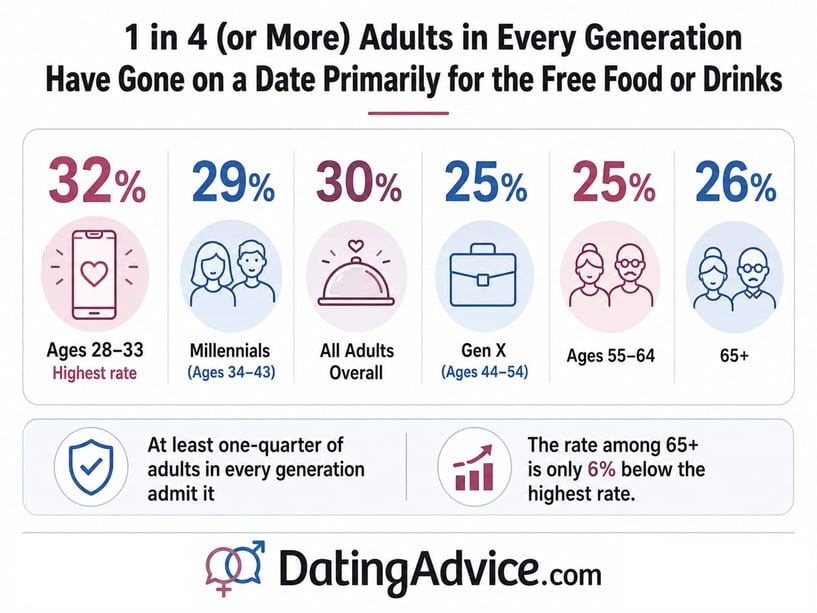
Even so, at least one-quarter of respondents in every reported age group had accepted a date primarily for food or drinks.
These daters don’t always have unethical intentions; sometimes a free meal is just that — a free meal that comes with a date on the side. But it’s important to remember how the over-50 crowd is often on a fixed income. Remember how some respondents said they like to confirm a date’s salary before going out with them?
It’s possible that some people over 55 years old aren’t responding to a “foodie call” so much as an opportunity for a free meal. It could be an economic decision more than anything else.
Dating Habits Change Remarkably Little After 55
We like to think that we’ll be far more evolved and enlightened versions of ourselves when we’re in our golden years. But in many ways, we’re exactly the same, especially when it comes to dating. Read through this study, and you’ll pick up on an interesting pattern: Both late middle-aged and older adults are on the same page about love.
No result in this set differs by more than two percentage points between the two groups.
For example, both age groups are increasingly open to technological solutions to age-old problems (accessing criminal records, for one, or double-and-triple checking a date’s profile photo for signs of catfishing).
Both age groups hold firm boundaries about rudeness and catfishing, yet they’re also both open to participating in morally-gray “foodie calls.” These similarities beg an obvious question: Why are these groups in such agreement?
The answer might lie in the fact that these age groups were raised at similar times and taught similar behavioral rules and habits. Or maybe it all comes down to life experience, and the fact that these age groups have more of it than their younger counterparts.
| Dating behavior | Ages 55–64 | Ages 65+ |
| Searched criminal or court records | 37% | 39% |
| Searched salary information | 18% | 17% |
| Walked out over rude behavior | 44% | 46% |
| Rejected an appearance mismatch | 36% | 36% |
| Dated primarily for free food or drinks | 25% | 26% |
Either way, we know one thing for sure: our dating habits are remarkably unchanged throughout life, even with added life experience. Our boundaries don’t seem to change much between age 25 and age 65, with safety taking permanent residence on our list of priorities.
If there’s any change at all, it seems to be a quiet confidence. Daters over 55 are increasingly comfortable using technology to their advantage, and they voice their boundaries without hesitation. This confidence is fueled by practicality: Why play coy when you can make stronger connections by being honest?
The only notable difference between dating before and dating after 55? Time — and how much older daters are willing to waste on people who don’t align with their needs and values.
Methodology
This survey was conducted among 1,016 U.S. adults through an online panel and was not limited to respondents ages 55 and older. All questions were single-selection and received 1,016 completed responses. For this study, DatingAdvice analyzed only responses from adults aged 55–64 and 65+.
The overall survey has an approximate margin of error of ±3.1 percentage points at the 95% confidence level. Because the findings highlighted here are based on smaller age-group subsets of the total sample, their margins of error are larger. Crosstabs by age and other demographic groups are available upon request.