


Flirting with an AI chatbot might not make most people’s list when asked to describe their worst cheating experience. But for the current generation, this is no longer a distant or far-fetched reality. And as technology continues to evolve, people are drawing new lines in their relationships.
According to a new study conducted by DatingAdvice.com in partnership with the Kinsey Institute, “State of Us: National Study on Modern Love & Dating in 2025,” 61% of surveyed singles say sexting or falling in love with an AI companion constitutes cheating in today’s digital age.
It’s not the first time technology has turned the dating landscape on its head. When online dating first appeared, it was heavily scrutinized and seen as a strange and desperate way to find a partner.
The internet was still fresh and new at the time, and people simply didn’t understand it. Now, online dating apps are a predominant avenue for finding a romantic or sexual partner.
Similarly, AI is opening a new world of uncertainty, with the debate on how it fits into the dating world heating up across the industry. Its influence on relationships is already emerging, from AI companion dating to science-based relationship coaching.
But we know that though technology can be used for good, it can also be leveraged to inflict harm, including creating mistrust in relationships.
DatingAdvice.com partnered with scientists at the Kinsey Institute to understand what modern daters think about infidelity and how technology factors into the puzzle.
Cheating Isn’t Just Physical: 72% Call Sexting Infidelity, 32% Call Out AI
The dating landscape has changed tremendously in the last few decades. How prior generations approached dating is nowhere near how the current one does. And technological and social norms have a lot to do with that.
Yet, amid these changes, infidelity remains the ultimate betrayal in romantic relationships. How people view cheating has seen some shakeups, but most people can agree on the impact it has on couples.
So what constitutes infidelity in today’s digital dating world?
According to our results, cheating isn’t just a physical act but can also be emotional, financial, and digital. And just like technology has permeated our daily lives, it has also reshaped how people cheat.
The following behaviors are the top forms of technology use that adults consider to be cheating in the modern dating playbook:
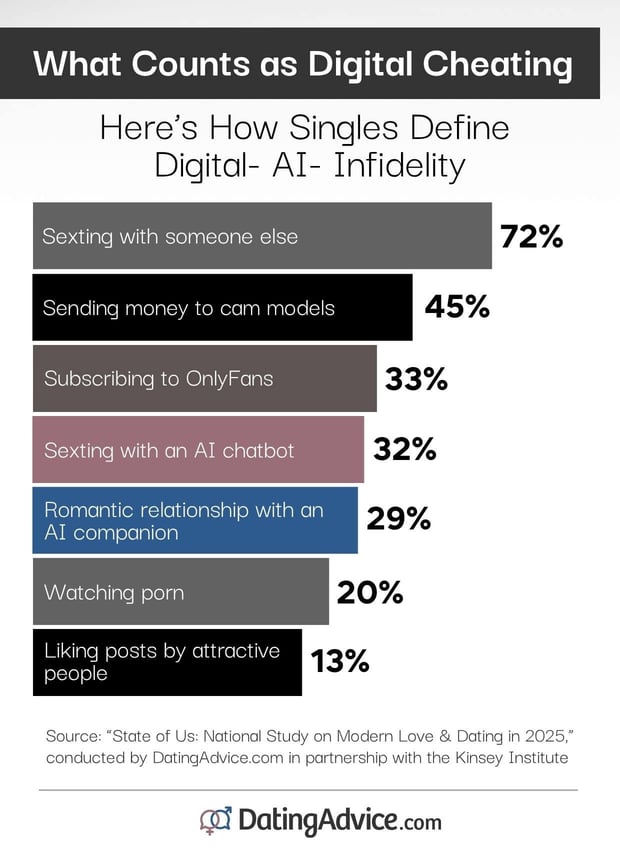
These results reveal a harsh truth: Though technology can support relationships, certain forms of technology use are widely seen as harmful to a relationship.
Interacting with AI chatbots may seem benign or maybe even beneficial to a relationship at first. But if these interactions are not properly managed, harmless intent can turn into insecurity for couples.
Kinsey Institute Research Scientist Dr. Amanda Gesselman, a lead researcher on the study, explains it best.
“These results challenge the way we’ve been thinking about digital behaviors. Modern daters recognize that technology-based connections can offer real benefits, including intimacy and support. For many, those benefits feel meaningful enough to pose a threat to their relationships.”
20% Have Snooped Through a Partner’s Phone or Computer to Catch Them in the Act
Cheaters aren’t the only ones going high-tech with their sneaky activities. Modern daters are also using digital tools to investigate and expose their partner’s questionable deeds.
Our findings reveal nearly half (48%) of singles surveyed suspected a partner was cheating on them in the past. Women were more likely to report suspicion of cheating than men — 54% vs. 43%.
Among those who suspected foul play, 85% said they did something about it. While 32% said they immediately confronted their partner about it, over 4 in 10 (42%) didn’t do so without pulling out their detective hats first.
Here’s how respondents gathered their evidence:
- 20% snooped through their partner’s phone or computer to confirm their suspicions
- 19% asked friends whether they had noticed anything suspicious
- 8% secretly followed their partner when they left home or work
- 5% used electronic surveillance to track their partner’s movements (e.g., location sharing on phones, AirTags)
- 3% installed hidden video cameras or voice recorders to catch their partner in the act
- 2% hired a private investigator to determine if their partner had cheated
Going into detective mode has its upsides, as the majority (81%) of respondents say they had their suspicions confirmed. Only 3% found out they were wrong about their partner, and another 16% said they never found out whether their partner was cheating or not.
Final Thoughts
As technology continues to evolve, so will the way it intersects with our relationships. While digital tools help us connect, they’ve also created new avenues for secrecy and betrayal.
Likewise, technology has supplied partners with new tools for investigating their suspicions, although these methods may be legally or ethically concerning and harmful in their own right.
Having open communication and understanding how technology, such as AI, can both help and harm our intimate bonds will be vital for couples going forward. After all, it’s not the technology, but how we choose to use it that shapes us.
Methodology
The DatingAdvice.com and Kinsey Institute State of Us: National Study on Modern Love & Dating in 2025 was led by Dr. Justin Lehmiller and Dr. Amanda Gesselman, with data collected and conducted by Prodege.com among a nationally representative sample of 2,000 single U.S. adults ages 18 to 91 via an online survey from April 29, 2025, to May 8, 2025.
The sample was balanced to ensure reliable and accurate representation of the U.S. population on age, gender, household income, geographic region, and race/ethnicity. Results of any sample are subject to sampling variation. The magnitude of the variation is measurable and is affected by the number of interviews and the level of the percentages expressing the results.
For the interviews conducted in this study, the chances are 95 in 100 that a survey result does not vary, plus or minus, by more than 3 percentage points from the result that would be obtained if interviews had been conducted with all persons in the universe represented by the sample.
Media inquiries can be sent to Colleen@datingadvice.com.