


Open relationships seem more popular than ever. Many of us know people who are dating non-monogamously, and if we don’t, we’re watching reality TV shows about finding a third.
As a sex therapist and relationship coach, I’m frequently fielding questions about how non-monogamy works and whether it might be right for my clients, from singles on the apps to longtime couples.
What does it actually mean when someone says they want an open relationship? I can understand why there’s confusion — there’s a lot to learn and keep up with when it comes to the various forms of ethical non-monogamy. Here’s what you need to know:
Defining Ethical Non-Monogamy
Ethical non-monogamy — sometimes called consensual non-monogamy or just “ENM,” for short — is an umbrella term that speaks broadly to the phenomenon of having romantic and/or sexual connections with more than one person with their full knowledge and consent.
At its core, nonmonogamy is a relationship paradigm that allows the people in it to pursue multiple romantic and sexual connections. Just as long as they have the consent of all involved.
Of course, this leaves a great deal undefined — what kind of romantic and sexual connections? What relationship, if any, do the people you’re dating have with each other?
The answers to these questions depend upon what structure of ethical non-monogamy you pursue.
The Basics of Open Relationships: 3 Things to Know
Open relationships usually comprise a main partnership — one that may have started out “closed” or monogamous — in which each person is free to pursue sexual, but not necessarily romantic, relationships outside of the partnership.
For many people, this is a first foray into non-monogamy, and it involves newly “opening” a longstanding relationship.
On the other hand, some people use “open relationship” as a shorthand for non-monogamy in general. It may be worth having a clarifying conversation about what your partner means by this term.
1. It’s Usually About Sex
In terms of how an open relationship works, most people in an open relationship have a primary long-term partner, but both individuals have consent to engage in sexual or romantic activities outside of their primary relationship.
2. It’s Usually Short-Term
It’s often expected that these connections outside the primary relationship are more casual or short-term, and may be more predicated on sex than emotional connection — unlike polyamory, which may involve potentially serious emotional connections with multiple partners.
3. It’s Particular to the Couple
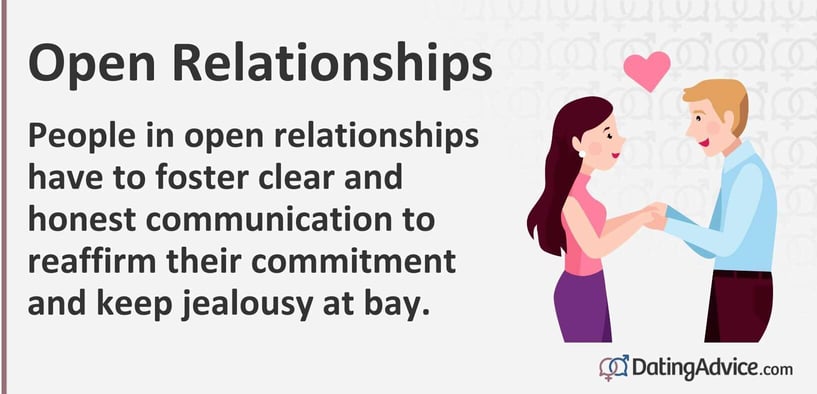
People in open relationships may have specific rules or guardrails for the types of connections they’ll pursue outside their primary relationship.
They talk about different scenarios that might arise and how to handle them in a way that respects the primary partner’s feelings.
This could mean only hooking up with a certain kind of person or having a certain kind of sexual contact. I know one couple who agreed to an open relationship dependent on gender – the male partner gave his female girlfriend permission to hook up with any woman she wanted. But she couldn’t hook up with any man.
Some couples in open relationships agree to tell each other everything about their outside connections. Some agree not to disclose any details in a “don’t ask, don’t tell” setup.
Other Similar Terms & Arrangements
Open relationships can have some overlap with other polyamorous setups, so it’s worth knowing the definitions of other relationship types in this space.
Monogamish Relationships
As the name implies, monogamish relationships have dynamics that look like monogamy in most important ways — but with occasional circumstantial exceptions.
In many cases, these are monogamous relationships with a few specific carve-outs or exceptions in which one or both partners can have romantic or sexual contact with people who aren’t their partner.

For instance, monogamish partners might agree to be romantically and sexually monogamous, but leave room for one-night stands on business trips (as long as you talk about them). Or they might sanction online-only flirtation with strangers who live in other cities.
Some couples keep a list of folks with whom either could sleep if the opportunity arose — a “hall pass.”
Being monogam-ish could also include sexual exploration as a couple, perhaps by attending a play party together, or having a threesome every once in a while.
In most cases, being monogamish is about staying emotionally connected with your partner while occasionally pursuing some sort of sexual experience outside your primary relationship.
Polyamory
Polyamory is a non-monogamous relationship structure wherein people have consensual, intimate connections with multiple partners simultaneously.
Polyamory can involve a wide range of interactions, commitments, and approaches, and it’s important to note that, unlike some forms of non-monogamy (like swinging), polyamory is very much not just about sex.
For many people practicing polyamory, it’s important to cultivate multiple meaningful emotional connections. They often balance multiple serious relationships of many years.
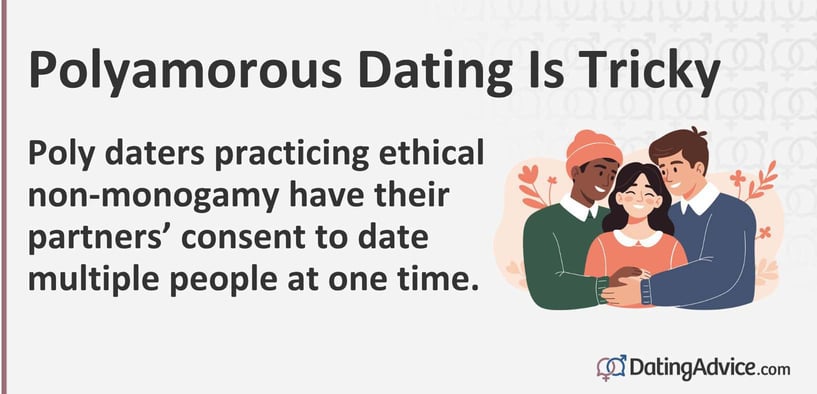
The nature of these relationships may be different — partners one lives with, partners one raises children with, partners one invests in a long-distance relationship with — but all of them are meaningful in their own way.
Hierarchical Polyamory
Within the larger umbrella category of polyamory, many different philosophies or structures exist. People who practice hierarchical polyamory with primary partnerships often have a primary partner they live with and/or are married to, and cultivate other connections as secondary to this primary one.
Others practice non-hierarchical polyamory, which can look like not giving any one relationship more weight than any other.
Non-Hierarchical Polyamory
Non-hierarchical polyamory can have some overlap with relationship anarchy, which organizes itself around autonomy and honoring each connection as it comes, without placing predetermined expectations on it.
Solo Polyamory
People who practice solo polyamory reject the concept of primary partners and consider their most important relationship to be with themselves. They may experience relationships with others as important… but not something to make big life decisions around.
Polyfidelity
On the other end of the spectrum is polyfidelity, where multiple people are in a committed, exclusive relationship with each other. This can look like a triad or throuple where the three partners only date and have sex with partners in the throuple.
Swinging
Swinging is a form of non-monogamy in which people in long-term partnerships or marriages decide to pursue sexual encounters with others as a couple. These sexual encounters are usually temporary and purely recreational, without serious emotional attachment or ongoing relationships.
This often looks like “swapping,” where two couples exchange partners for an evening, with specifically agreed-upon sexual activities that are on the table.
Swingers might also be looking for a “unicorn,” aka a bisexual woman who likes to play with couples. As the name suggests, such a person is hard to find.
Swinging is distinct from an open relationship or polyamory in a few ways; most notably, couples who swing organize all their connections as a couple.
- Requires closer collaboration
- Less autonomy
- More couple-on-couple action
Couples in an open relationship or open marriage might have some guidelines or rules in place, but they pursue dates and partners independently of each other.
Couples in a swinging relationship generally make decisions about who they’ll sleep with together. They need to reach a consensus about any swinging or swapping that takes place.
This may be in the context of swingers’ parties or events, or with other swinging couples who have connected over an app or online. Swinging couples may play with others together or separately, or in a group.
Learn the Lingo
Soft Swap: Couples play around but set limits on how far they’re willing to go.
Full Swap: Couples fully switch partners and engage in sexual exploration. No limits.
Hotwifing: A married woman has sexual escapades with her husband’s blessing. Sometimes he likes to watch.
Couples-Only Swinging: The couple will only swing as a pair. They stay together when playing with individuals or couples.
Much like any form of non-monogamy, swinging is based on full communication and transparency with all involved.
Swinging tends to be a group activity. There are swinger communities that form around the idea of attending parties where anything goes and partners can swap freely.
Because so many people are involved, it is imperative to have clarity on the boundaries in your relationship. Are you open to a full swap? Half swap? And what methods will you use to practice safe sex?
Open Relationships Are All About Communication
Now that you know the lingo, you can decide what’s right for you and your relationship. This isn’t a one-size-fits-all situation by any means. I’ve seen couples come up with all sorts of rules and arrangements that fit their lifestyles.
Open relationships look different from couple to couple, but they all involve clear consent from people in the relationship.
As long as you communicate your expectations and boundaries, you can play in the world of polyamory and create connections that fulfill your romantic desires.