


Maybe you’ve always been interested in ethical nonmonogamy but have never had a chance to try it. Maybe you’ve become newly intrigued after getting to know more nonmonogamous people.
Being exposed to the lifestyle as part of a new friend group or new romantic interest can be exciting…But if you’re already in a monogamous relationship, pursuing this interest requires a conversation with your partner about opening your relationship — and that can feel fraught.
I’ve seen so many of these conversations in my tenure as a sex and relationships therapist. As a result, I have a keen sense of what makes these discussions work when they’re successful — and what sets them up for failure and resentment.
Here’s how I’d think about asking your partner if they’re open to an open relationship:
Check on the Health of Your Relationship
Our relationships are complex, even before we get into questions of exclusivity or non-monogamy. The subject of opening the relationship is a weighty one, and it can push some hot buttons.
Open relationships bring up questions about: sexual desirability, insecurity and jealousy, the idea of being “enough” for our partner, or fears about our partner leaving us.
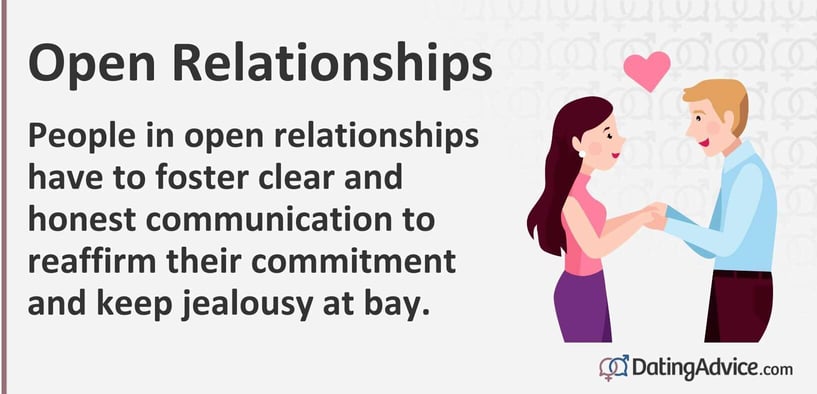
It’s virtually impossible to have a conversation about opening up your relationship without any of these issues being on the table.
If you want to avoid an unnecessary conflict, it’s a good idea to do a temp check on what your relationship has been like lately to make sure none of these issues are currently flaring up or extra sensitive.
It’s also good to be mindful of any preexisting resentments, chronic disagreements, or sore points in the relationship, even if they seem to you to be totally unrelated to nonmonogamy.
Even if your partner doesn’t experience sexual jealousy at all, if you’re springing the idea of an open relationship on them after months of arguments about how little time you have to spend with them, you may open an enormous can of worms.
You don’t want to walk into accusations like: “You have so little free time, and you want to spend it pursuing new dates rather than with me?”
While no relationship will ever be entirely without friction, doing your best to address long-standing pain points in good faith is a really good way to set up any forays into nonmonogamy for success.
Decide the Stakes
How important is the idea of an open relationship for you? Or, put another way, what will you do if your partner says no?
It’s helpful to go into things with a sense of what the stakes are for you on this issue, and why you’re asking.
If this is important enough that you’d end the relationship rather than stay monogamous, you might conduct it a lot differently and need to communicate the gravitas of the decision to your partner (without making it an ultimatum).
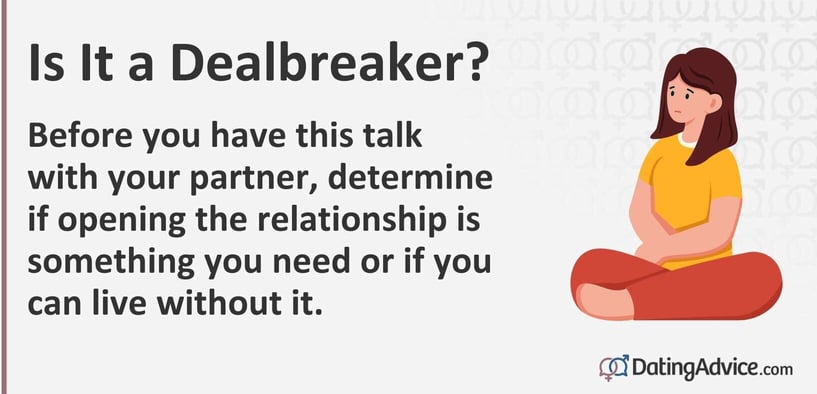
On the other hand, if this is something where you’d love to hear an enthusiastic yes but will understand and would be happy to stay in the monogamous relationship, you can show up to this conversation with a lighter approach about inviting your partner to consider other possibilities.
Consider why you’re interested in an open relationship and how to best communicate this to your partner — so they can understand where you’re coming from without feeling attacked or found wanting.
Your goal is to have a constructive conversation, even if an open relationship isn’t appealing to your partner.
Make It a Conversation, Not an Announcement
One of the surest ways for a conversation about opening the relationship to go badly is to make it one-sided.
What not to do: Announce to your partner that you want an open relationship. Move forward with no input from them or curiosity about their feelings and thoughts.
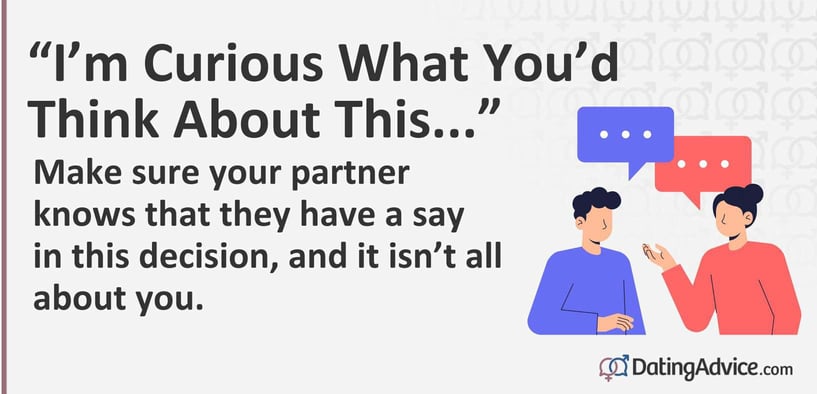
Another surefire way to make this go badly is to go in with the goal of convincing your partner that an open relationship is what’s best for you. Instead of asking their opinion, you’re getting them to agree with you.
Think about it this way: You know how you feel about an open relationship; the purpose of this conversation is to find out how your partner feels about it.
Look to understand the similarities and differences in your mindsets.
Don’t Bring in a Third Yet
Sometimes, we’re interested in an open relationship because we’ve already met someone we’d like to be dating outside of our monogamous connection.
In my experience working with couples, it’s rare that both partners feel the exact same way about this issue.
While this can add a lot of urgency and sense of stakes to the idea of an open relationship, it can be hurtful and alienating to your partner to lead with the idea of a specific, living, breathing new person you want to be intimate with before they’ve had a chance to wrap their head around the idea of other people at all.
It’s not helpful to lie about not being interested in someone else, but try to lead with a conversation about nonmonogamy as a general practice before delving into a pitch about the person you met in your meditation class or at a party.
Give Yourselves Time
It’s not necessarily realistic — or a good idea, even — to come to a firm decision by the end of one conversation.
Even if you both feel enthusiastically on board, there are a lot of details in terms of what you’d want your open relationship to look like that need to be considered. I always say it’s best to sleep on it and talk again the next day.
Rather than planning for one conversation, in fact, better to plan for opening the topic and then letting it be a matter of discussion for a period of weeks or even months.
This gives both of you a chance to metabolize your hopes, fears, and fantasies about opening your relationship, and talk through questions or concerns as they come up.
You may even want to take this time to start working with a couples counselor or therapist if you aren’t already.
Similarly, if you do end up opening your relationship, it’s not a race — don’t feel like you need to rush into anything, but let things happen organically and at their own pace.
Nail Down the Details & Establish Boundaries
Let’s say you and your partner discover you’re on the exact same page — they’ve also been wanting to ask you for an open relationship! Or, perhaps more realistically, let’s say that after some back and forth and reflection you decide to give it a shot.
It’s probably still not time to hit the streets or join Feeld quite yet. It’s helpful for you and your partner to figure out what the shape and structure of your open relationship should be, as everyone is different.
Are there guidelines about who either of you can date or in what context? Is it important, for instance, to avoid mutual friends or acquaintances, or people you work with?
Are there intimacies, either romantic or sexual, that you want to reserve for the two of you? Are you imagining this as a space for you to form emotional connections and relationships with other people or just seek out casual sex?
What about the impact this may have on the quality time you two are able to spend with each other? Are there regular date nights or rituals you want to make sure to keep on the schedule?
Asking and answering some of these questions will help set your open relationship up for success.