



Your coworker, Lexi, just moved in with her partner, Joe. You’re at their housewarming party, admiring how in love they are. You fill up your plate with crackers and hummus, and when you return to the table, Lexi is snuggled up against someone else, feeding him fruit.
Lexi sees your look of confusion, smiles, and says, “Have you met Kyle? He’s my secondary partner.”
You feel flooded with judgment and confusion. Secondary partner? Is this another way of referring to Kyle as her casual hookup? Is there a third-place partner in the mix? Are Lexi and Joe really as happy as they put on?
A primary partner in a polyamorous relationship takes precedence over others and often involves high-level commitments, like marriage, living together, or raising children.
As ethical non-monogamy becomes more mainstream, you’re likely to encounter terms like primary partner and secondary partner. From advice columns to dating shows, polyamorous relationships are less stigmatized, with an estimated 4-5% of Americans identifying as polyamorous.
Not all polyamorous relationships use the primary/secondary structure, but it’s common. As a dating expert, I see a lot of misconceptions around polyamory (or “ethical non-monogamy”), specifically around the ideas of primary and secondary partners. I’m here to break down what exactly these terms mean.
What Primary Partner Means in Polyamory
In the scenario described above, Joe would be Lexi’s primary partner. They live together, sharing finances and making life decisions together.
A primary partner in a polyamorous relationship takes precedence over others and often involves high-level commitments, like marriage, living together, or raising children.
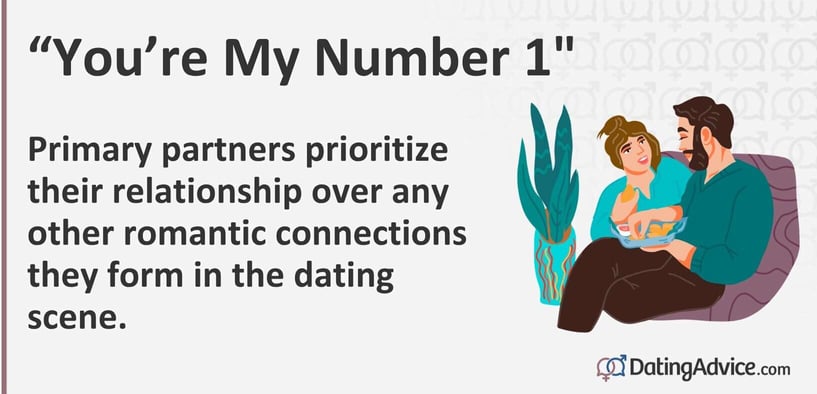
A primary partner can also refer to a more stable, serious relationship that doesn’t involve a high-level commitment.
When two people who are already in a committed relationship decide to become non-monogamous, they remain each other’s primary partners.
What Secondary Partner Means
Lexi might see Kyle once a week for a date night. They might go on trips together, regularly text and call, and be involved in each other’s social lives.
But as Lexi’s secondary partner, Kyle does not take precedence over Joe.
Loosely, the term “secondary partner” refers to a partner outside the primary relationship. While a secondary partner is often not involved in cohabitation or shared finances, they still offer companionship, emotional support, and/or sexual intimacy.
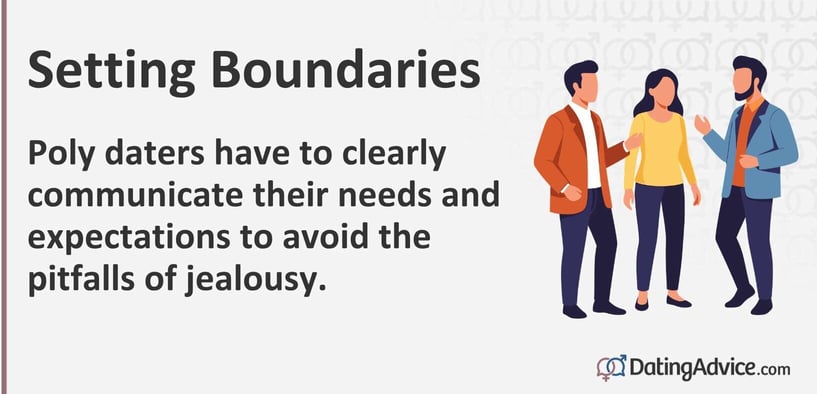
A poly person might be a secondary partner in one relationship and have a primary partner of their own at home.
Some people practice solo polyamory and prefer to be secondary partners with none of the obligations of a primary partner.
The most important thing to understand: there is no one-size-fits-all description of a secondary partner. Like all relationships, the dynamic is up to the people in the relationship!
Hierarchical vs Non-Hierarchical Polyamory
The polyamorous relationship I’ve just described – having primary and secondary partners – isn’t the only way to be polyamorous. It’s just one of many configurations of polyamorous relationships.
Polyamorous relationships can be broken up into two camps: hierarchical and non-hierarchical. Each has different blueprints for how relationships are organized, based on how people want to manage their priorities, time, and ideas of power within their relationships.
I’ll go through how these relationships work and what the upsides are.
Hierarchical Polyamory
In Kyle, Lexi, and Joe’s dynamic, there is a hierarchy. Lexi’s primary partner holds the number one spot in the hierarchy, and her secondary partner holds (surprise) the second.
Hierarchical polyamory can offer a stronger sense of structure and security. This relationship structure creates security for the primary partners.
This setup makes sense for existing couples exploring polyamory together. The people who are in a long-term relationship obviously want to ensure they remain committed and a priority in each other’s lives.
You may be asking, “What’s in it for the secondary partner?”
Pros
- Intimacy without commitment
- Permission to date other people
- Flexibility in scheduling
- Freedom to come and go as they please
Cons
- Potential for jealousy
- Less relationship stability
Some secondary partners have a primary partner of their own, but many don’t. They might have other commitments that take up time in their life – a demanding career, frequent travel, an absorbing hobby – that make a long-term, primary relationship unsustainable.
Comedian Taylor Tomlinson opened up about dating a polyamorous person in her Netflix special Prodigal Daughter. “I didn’t think I was going to like dating somebody poly. She was poly. I was busy,” she joked.
Taylor said her relationship with a poly person was the most communicative and healthy one she’s had… until she got dumped.
“Ever get dumped by a polyamorous person? It sucks. It’s like getting fired from a part-time job.” -Taylor Tomlinson
Some secondary partners prefer having the advantages of a romantic connection without the commitment of an intensive one-on-one relationship.
The downside is that the structural inequality of the relationship can foster jealousy and insecurity.
Joe might be jealous of how much time Kyle and Lexi spend together. Or Kyle might envy the intimacy and inside jokes that Lexi and Joe have. Clear communication and validation are essential to keeping people happy in hierarchical polyamory.
Non-Hierarchical Polyamory
This is also known as “relationship anarchy.” Non-hierarchical polyamory is a term for having multiple relationships without any ranking or system of importance.
Rather than having established structures, non-hierarchical polyamory allows relationships to fluctuate, grow, and exist on their own terms.
For example, Alex is dating Lily and Anisha. Alex considers both relationships equally important. Alex might spend more time with Lily one month, and more time with Anisha another month, depending on how the relationships organically develop and what each partner needs.
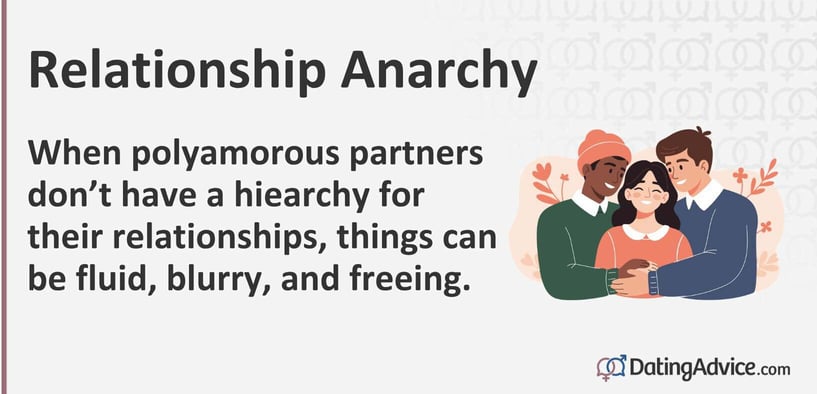
In non-hierarchical polyamory, one relationship does not inform what plays out in another. All partners (ideally) have equal autonomy. There are no secondary or primary partners. Just partners.
With clear, intentional communication, non-hierarchical polyamory can be the ideal polyamorous structure for people who value autonomy and the freedom to explore.
The upside is that relationships aren’t pitted against each other and compared as directly as they are in hierarchical polyamory.
But some challenges can come with stripping away the “primary/secondary” safety net.
Non-hierarchical polyamory requires intentionality and emotional labor. Without a prescribed structure, honest communication is crucial to managing relationship dynamics with all partners and making sure everyone’s needs are met.
4 Common Misconceptions in Poly Relationships
A lot of people misunderstand ethical non-monogamy because they haven’t experienced it or met anyone practicing it. They see stereotypes in pop culture and mistake them for the truth.
Here are some common misconceptions I’ve seen around hierarchical polyamory that uses a primary/secondary structure.
Misconception 1: Secondary Partners Matter Less
The truth: Partners are labeled “secondary” due to structural placement, not because of a lack of emotional depth or value. A secondary partner might not involve cohabitation or shared, high-level investment, but the level of emotional investment is up to the people in the relationship!
Misconception 2: Primary Partners Control Each Other’s Relationships
The truth: Setting boundaries is different from controlling a relationship. While primary partners get to set boundaries with each other about who they see outside of the relationship (i.e., not making plans without first checking in), this doesn’t mean they dictate each other’s emotional or physical intimacy with secondary partners.
Misconception 3: The Labels Are Permanent
The truth: The map of any relationship is not locked in forever. Polyamorous structures are often fluid as life circumstances and relationship dynamics shift.
Misconception 4: Everyone in Polyamory Uses the Same Labels
The truth: Each polyamorous person gets to dictate how their relationships look and what terms they use. If you’re interested in learning more in-depth about different polyamorous terms, check out this guide.
Clear Communication Matters More Than Definitions
The labels of “primary” and “secondary” aren’t about ranking someone’s worth. They’re simply tools used in a relationship to navigate logistics, time, and life goals.
Whether a relationship is monogamous or polyamorous, hierarchical or non-hierarchical, different structures can allow people to build romantic lives that fit their unique needs.
Partners in a relationship should define what labels mean for themselves and go with what works for them.