


In my practice, I support clients through a range of dating and relationship challenges — and sometimes someone is working on fully understanding or metabolizing new dating experiences.
Whether it’s someone’s first serious live-in relationship, first queer relationship, or first time dating after divorce, we continue to have new dating and relationship experiences throughout our lives that we need to process.
In some cases, this might mean encountering new sexual orientations, genders, or lifestyles that we aren’t previously familiar with — and in a romantic or sexual context, this can mean a learning curve about new identities and communities.
Maybe some terms, like “pansexual,” are new or unfamiliar — but they don’t have to stay that way.
Here’s what you need to know about pansexuality, and what it means to date a pansexual person.
What Does Being Pansexual Mean?
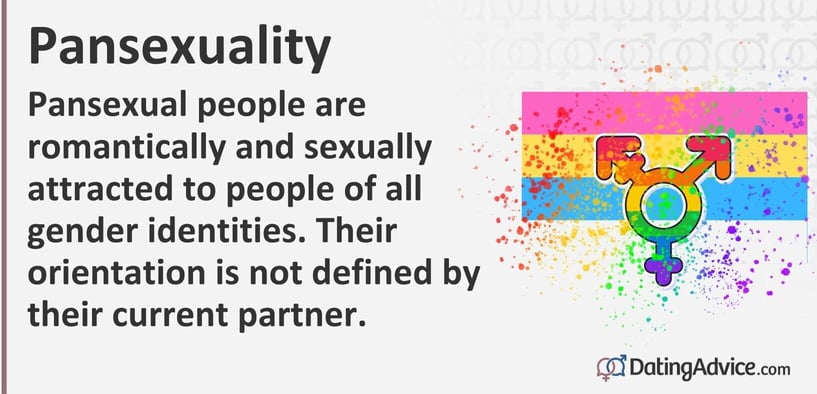
Pansexuality comes from the Greek prefix “pan,” referring to “all” or “every.”
It means being attracted to all genders (or being attracted to someone regardless of gender).
Pansexuality as an identity is predicated upon an understanding of gender as a wide spectrum or multiplicity rather than a simplistic male-female binary.
Beyond this basic definition, there are as many ways of being pansexual as there are pansexual people. Some pansexuals feel entirely gender-blind, meaning their attraction and romantic interest in others is in no way influenced by gender.
Some feel they’re attracted to a range of different genders in different ways.
People who identify as pansexual may also identify with another sexual orientation, like bisexuality, omnisexuality, or queer — they may also refer to themselves with the shorthand “pan.”
Pansexual people may have any gender themselves, including trans and nonbinary genders, and they may be interested in any kind of relationship orientation.
The term “pansexual” may seem novel, but the idea has been around a long time — the term “pan-sexualism” was first coined in the early 1900s, though the connotation was slightly different.
In the late 2000s, the term gained new popularity among LGBT people working to integrate a more updated understanding of trans genders into their vocabulary and understanding of self.
How Is Pansexuality Different From Bisexuality?
Although pansexual and bisexual are different terms with important distinctions, there are significant overlaps both in the meaning of these terms and the communities that use them.
Bisexuality is generally understood as attraction to one’s own and other genders, with the prefix “bi” meaning “two” referring to this distinction.
Some people have understood bisexuality to mean “attraction to two genders” and thus a reification of the cis male/female binary. Some people have identified as pansexual as an affirmation of trans genders and their own romantic and sexual interest in trans people, though the bisexual community generally rejects this reading.
In short, pansexuality isn’t technically the same thing as bisexuality. In theory, someone who identifies as pansexual is attracted to or is open to dating all genders, whereas someone who identifies as bisexual could refrain from dating some gender identities (for instance, some people choose not to date cis men).
However, in practice, these identities and communities have an enormous amount of overlap, and it’s not uncommon for someone to identify with or use both terms interchangeably.
Are Pansexuals Non-Monogamous?
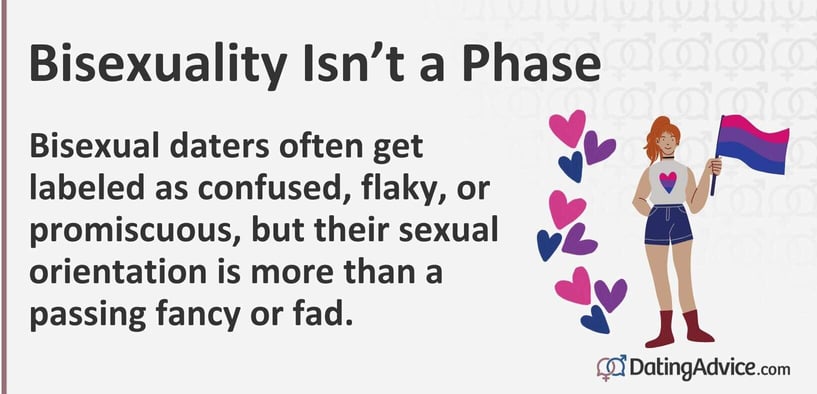
It’s a common stereotype applied to folks adjacent to bisexuality, including pansexuals, that they’re greedy or promiscuous — some people believe that people who are attracted to multiple genders can’t possibly be satisfied with dating only one person.
This can lead to a misconception that all pansexual or bisexual people are non-monogamous or polyamorous.
In reality, someone’s sexual orientation doesn’t necessarily have any relationship to their preferred relationship structure.
Many (even most!) non-monogamous or polyamorous people are straight. And, in my experience, many pansexual or bisexual people are monogamous.
Being attracted to multiple genders doesn’t mean you are more likely to be non-monogamous or that you can’t be satisfied by one partner or by one gender.
Dating a pansexual person involves an honest dialogue about relationship expectations like any other — you should talk about whether you’re interested in being exclusive or in continuing to see other people, and whether non-monogamy is something either of you is interested in.
But by no means should you assume that someone is going to want other partners or a non-monogamous relationship structure purely on the basis of their sexual orientation.
After all, a straight woman who’s interested in men has presumably been attracted to men besides her monogamous partner — that doesn’t mean she needs to date all men to feel fulfilled or get her needs met.
Advice for Handling Jealousy in a Relationship
Even when they’re in a monogamous relationship, some people may feel insecure or hung up on comparison to others because they know their partner is also attracted to people of other genders.
“After all,” we may think, “I can’t offer the same things that people of a different gender can; maybe there will always be things that my partner is missing as long as they’re with me.”
We may get in our heads comparing ourselves to past dates our partner has had. Or maybe we obsess over people we imagine they might be attracted to, like celebrity crushes.
In reality, dating a pansexual person doesn’t mean other people are any more of a threat to your relationship than they would be if you were dating a straight or gay person, and it doesn’t mean that your partner is inherently unsatisfied by you.
Think of it this way: if you were dating someone who was only attracted to people of your own gender, there would still be differences and unique traits in each person they’re interested in. You will never be as tall as some people or have as high an income as others; that doesn’t invalidate your partner’s attraction to you.
You’ve also been attracted to other people before; that doesn’t mean you find your partner lacking or disappointing in comparison.
Dating a Pansexual Person Isn’t So Different
If you’re a straight person who’s dated other straight people all your life, do you need to suddenly question your heterosexuality if you’re dating a pansexual person?
No, you don’t — your date’s sexual orientation functions completely separately from their gender or gender identity, and their sexual orientation says nothing about your own.
If you’re a straight person dating a queer-identified person for the first time, it’s entirely possible that it could be eye-opening for you in such a way that you end up doing new self-examination around your identity.
But dating a pansexual person on its own does not make you queer or pansexual if you weren’t already (or, conversely, make them straight if they weren’t before!).