


Key Takeaways
- 40% of people surveyed said they’ve researched a date’s criminal or court records before meeting up, with men and women nearly equally likely to do so.
- 46% of Gen Z adults have conducted a background check on a date, the highest rate among all demographics.
- Of those who ran a background check, roughly 1 in 12 say the check led to a canceled date because of what they found.
From fake profiles to scam artists, singles have to consider a slew of safety concerns in the online dating world. And instead of leaving their security to the mercy of dating app developers or bad actors, daters are taking the initiative to verify their matches themselves.
A recent DatingAdvice.com survey found that 4 in 10 U.S. adults have researched a date’s criminal or court records before meeting, highlighting how integral safety and security have become in modern dating.
While dating apps have allowed singles to find matches at will, they have also brought new security concerns to the surface.
In the past, people could rely on community, such as family, friends, or coworkers, for vetting dates. Today, public records have filled that role for many singles, as they meet more people online.
Men and Women Are Nearly Equally Likely to Research a Date’s Criminal History
In the age of online dating, security has become a priority for many singles. And while the narrative may point to safety primarily being a concern for women, our data shows otherwise.
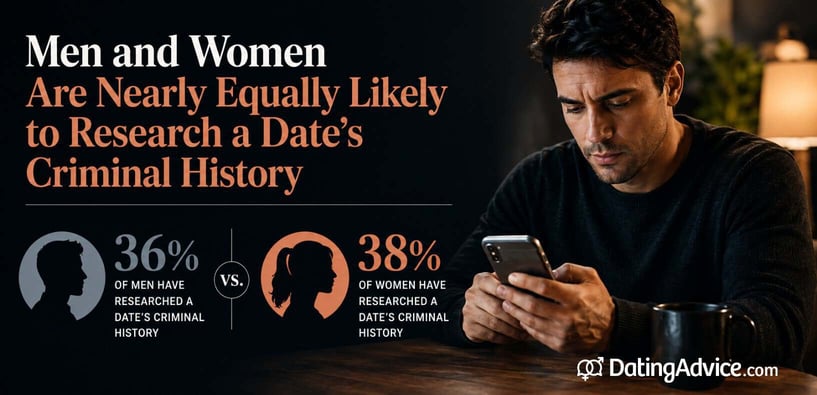
Men and women were nearly equally likely to say they ran a background check on a potential match before a date — 36% v.s. 38%. This tight, two-point spread suggests that both men and women have safety concerns when pursuing matches.
Daters Ages 18-34 Are the Biggest Background Checkers
As for generational differences, we found that younger people were more likely to research a date’s criminal history than other generations.
Nearly half (46%) of Gen Z adults aged 18 to 24 say they have conducted a background check on a date. Older Gen Z and millennials (42%), ages 25 to 34, followed close behind.
Younger people also grew up with information at their fingertips. So it’s no surprise that research has become commonplace in their dating lives.
Would You Run a Background Check Before a First Date?
- Yes
- No
These findings also reflect differences in dating app usage across generations. According to the Pew Research Center, 53% of Gen Z have tried a dating app, followed by 37% of millennials.
In contrast, a far smaller share of older adults have used them. Only 20% of Gen X and 13% of boomers surveyed said they have used a dating app. These results suggest that younger adults may conduct more background checks because they are meeting more people online, compared to other age groups.
The Midwest Leads America in Pre-Date Vetting
Our study also found regional variances in pre-date vetting across the U.S. Interestingly, despite its reputation for friendliness, the Midwest stood out for its use of background checks in dating.
Over 4 in 10 (41%) people from the Midwest said they researched a date’s court records before going out. Here is how the other regions fared:
- The Northeast: 39%
- The South: 36%
- The West: 34%
While the Midwest led our findings, the gap between it and the lowest region was only 6 percentage points, showing that background checks are a common practice nationwide.
1 in 12 Background Checks Led to a Canceled Date
Researching a date’s criminal background can prove to be resourceful, according to our results. Among respondents who ran a background check, roughly 1 in 12 (8.5%) said their findings led to a canceled date.
While cancellations weren’t common overall, a meaningful share of people still walked away from a potential match based on the information they found.
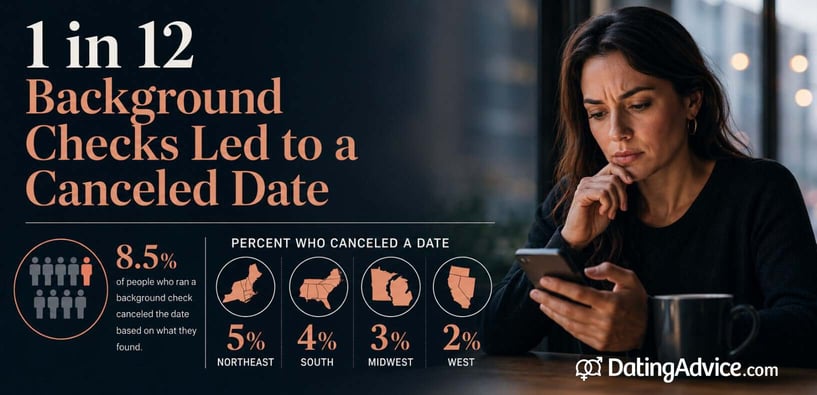
Out of those who did cancel a date, singles from the Northeast were the most likely to walk away. About 5% said they canceled a date, followed by singles from the South (4%), the Midwest (3%), and the West (2%).
Given the small percentage who canceled, the data suggest that background checks may be more about verification than suspicion. Singles who research their dates are probably seeking reassurance to move forward with a match they like, rather than just hunting for dealbreakers.
While dating apps have certainly widened the dating pool, our results point to the broader conversation about safety in online dating that singles are already having. Given the concerns, it’s evident singles want stronger verification methods before meeting online strangers in real life.
Yet, they aren’t waiting on dating apps to provide them protection. By being proactive with background checks and other safety practices, singles are protecting themselves and building trust in their relationships on their own accord.
Methodology
This survey was conducted among 1,016 U.S. adults via an online panel. The overall margin of error is approximately ±3.1% at 95% confidence. All questions were single-selection, and each received 1,016 completions. Crosstabs by demographic group (gender, generation, U.S. region, etc.) are available upon request.
Media inquiries, please contact colleen@datingadvice.com.