



Spotting a catfish in today’s world of AI chatbots and photo filters can be tricky. Scammers and con artists cost Americans nearly $12.5 billion in 2024 alone. Many dating apps are adopting more vigorous verification features to combat rampant lying.
First, it’s important to recognize what kind of catfish you’re dealing with. There are two kinds. The first one I call a “Deceiver” and the other more sinister variety I call a “Defrauder.”
The Deceiver is not who they say they are, but often it’s because they are too ashamed to reveal their true self or are living another life (usually married). They are online dating for an ego boost, an escape, or entertainment purposes only.
A Defrauder has more sinister motives of taking money from you in the form of bill payments, fake cryptocurrency, unusual investments, or gift cards.
A Deceiver is one person. A Defrauder may be either a person or an entire network of scammers working together to steal from hopeful romantics. But they both have similar tells.
I want all online daters to look out for the red flags of a catfish. If you see these signs, you should proceed with caution… or abort the mission entirely.
1. Photos Mismatch
Ask yourself if the profile makes sense as a cohesive collection. Are there pictures that seem out of place, or is it hard to tell if all of their pictures are truly of the same person? Catfishers might try to mask their identity using group shots or framing themselves far away so you can’t clearly see their face.
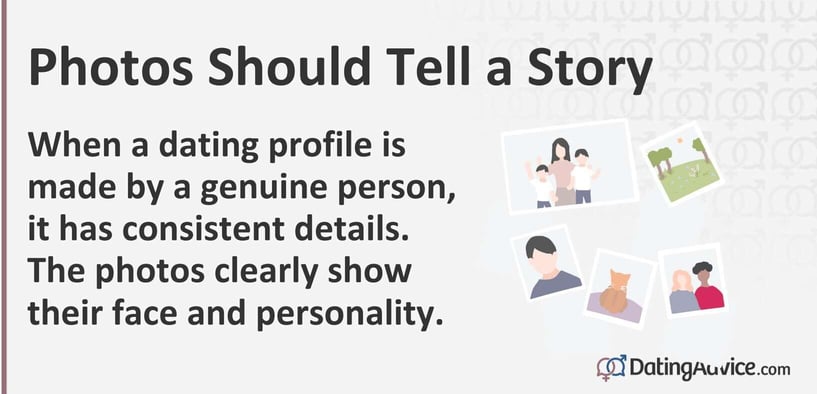
Often, beautiful vacation photos will be incorporated to make you fall in love with the idea of an adventurous, exciting life with them, while hiding the fact that the photos are of different people.
It’s also common that a catfish will have only the minimum number of photos because the more pictures they use, the more open to questions and inconsistencies they will be.
2. Stock Images or Model-Quality Photos
Look out for photos that seem to be too good to be true, like they could have been pulled from a magazine…they probably were.
Photos of a person in uniform can be a catfishing red flag as well. This goes for police officers, military, firefighters, and even doctors in scrubs. Portraying themselves as any of these professions is meant to garner immediate trust. These photos are often stolen from websites, professional profiles, and other online resources.
3. Basic Grammatical Errors
If the syntax of their profile seems off or they have egregious misspellings of common words, that’s a red flag too.
Many honest people use punctuation incorrectly, forget a comma, or misspell a word here and there, but catfishers often speak in broken English with obvious grammatical mistakes.
If they don’t seem to be a native English speaker but claim to be born and raised in Minnesota, exit that conversation immediately.
4. Inconsistent Personal Details
Catfishers are making up their backstory, usually as they go, so there might be slip-ups, like they said they always get a take-out dinner after work, but also claimed to work late-night shifts into the wee hours. Or they changed how many siblings they have or what they do for a living.
Look for discrepancies in anything they’ve written or between what they’ve written and what their photos are showing you. If you call them out, catfish will often have a hasty explanation at the ready …but do not fall for it.
5. Generic Statements
If you reread their messages and think, “Could they have sent this same message to my sister, friend, or anyone else?” They probably did.
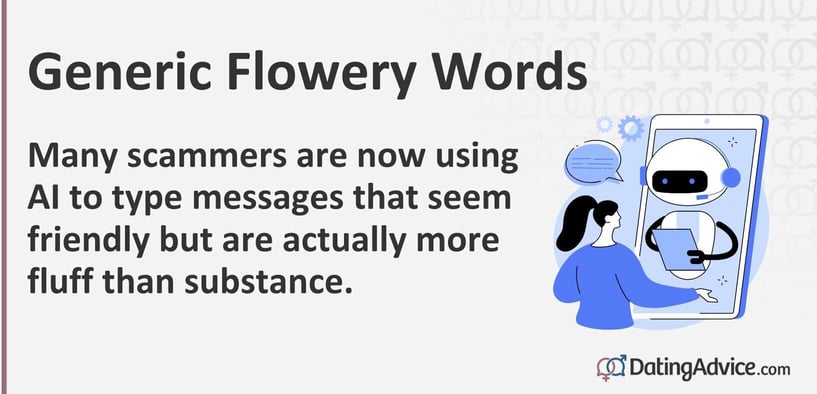
The statements a catfisher makes tend to be grand and emotional, but by taking a step back, you might realize they could have cut and pasted the information to dozens of matches.
This goes for “good morning” texts as well. Assume that if there’s no specific information to you or about what you’ve shared, they are sending that same message to other people and hedging their bets.
6. Swapping Platforms
Do they push you to move to Signal or WhatsApp within a week or two? These apps are Deceivers’ favorites because the messages are encrypted and can be made to disappear. Also, the app can’t track what they’re doing and block them automatically.
It’s harder to get accountability because such apps don’t maintain a record of your conversation.
7. They Dodge Meeting Up
This could be something a Defrauder would do as well, but it’s more often a Deceiver move. Any real match should have no problem doing a FaceTime or Zoom with you or making a plan to meet in person. If they are not motivated to have a real face-to-face conversation, something is most certainly off.
8. Asking for Money
The #1 red flag! If you have not met in person and formed a reciprocal offline relationship, there is no reason to send money. Deceivers will tug on your heartstrings for weeks, only to hit you with an emergency request or a quick favor.
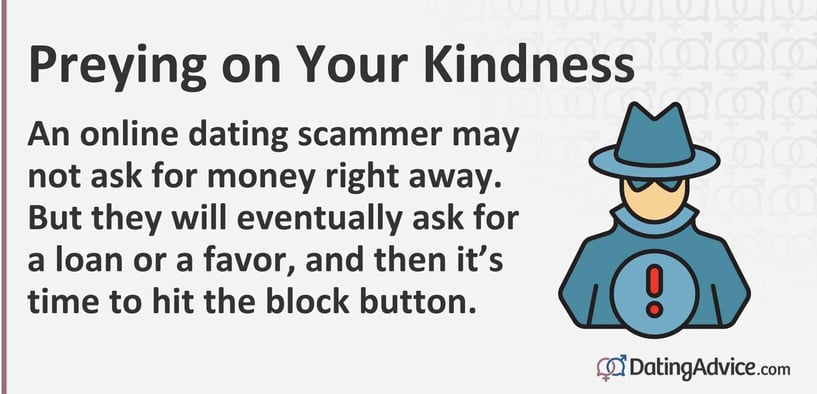
They may ask for a little bit of money at first. Then, if they realize they have a live one on the hook, the requests will increase and before you know it, they’ve cleaned you out.
What To Do If You’re Suspicious (3 Steps)
It can be hard to know what’s real and what’s a lie when you’re emotionally hooked. Catfish are getting more sophisticated and savvy with better tools and masterful skills of deception.
Any of the above should make you suspicious. You shouldn’t work too hard to make the inconsistencies make sense.
If you end up spotting a beige flag and can’t tell if the person is deceiving, defrauding, or just plain dumb, I have a simple three-step fact-checking system:
1. Reverse Image Search
You can do this within Google directly and see if there are any similar images that come up associated with their photos, or pull up names that are different from names they’ve shared with you.
2. Check LinkedIn
If your match is a true professional, they likely will have an up-to-date LinkedIn profile where you can cross-reference information they have given you.
Check their LinkedIn photos against their dating profile pics. See if the details line up. And if you don’t see a LinkedIn page, ask them why they don’t have one.
3. Look Them Up on a People Search Site
If you have their phone number, full name, or email address, you can often do a quick lookup on a people search site to see if they have any arrests, liens, or bankruptcies.
Then correlate the information you get with what you believe you know about them. If you find any inconsistencies, pay attention.
And if you find no information, that is sometimes a smoking gun in itself.
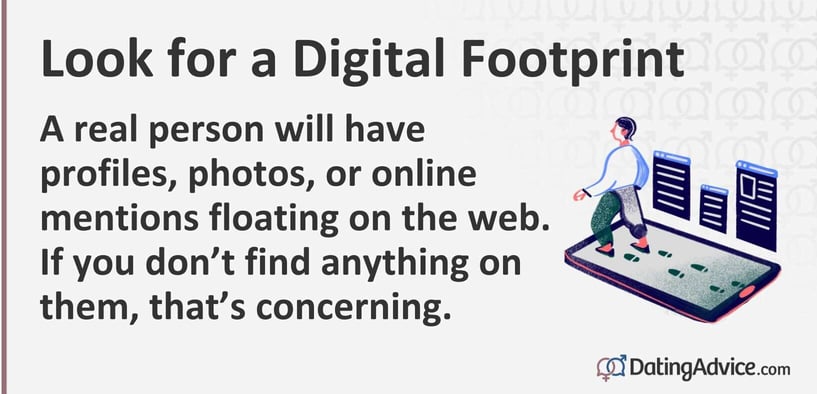
Often a quick background search will reveal the Deceivers and Defrauders, and you can take it a step further by escalating the conversation in different ways. Ask for personal details, invite them on a video call, or outright challenge them to prove themselves.
Stay Skeptically Hopeful Online
We hear so many stories of the little old lady or poor widower getting duped online. It’s heartbreaking, but it often follows a similar pattern. And older people aren’t the only targets.
Avoiding catfish is unfortunately a necessary part of dating today, but if you are armed with the right tools and aware of the most common red flags, you can navigate away from Deceivers and Defrauders and toward meaningful connections.