



Bright red lipstick on a starched white shirt collar. Unexplained purchases on a shared bank statement. Repeated “late nights at the office.” No matter how much you trust your spouse, you have to admit that this behavior would leave you with a raised eyebrow and a pit in your stomach.
Fortunately, these hallmarks of infidelity are usually confined to bad romance novels — for the most part, anyway.
Those of us who have dealt with infidelity firsthand understand just how destabilizing it can be, especially since modern infidelity is far from straightforward. Modern thoughts on monogamy, AI, and trust have made our definitions of infidelity much more personal.
These statistics highlight the widening gray area between “harmless flirt” and “guilty cheater.” And even more importantly, they bring conversations about infidelity out into the open and allow us to decide for ourselves when our partner’s late nights at the office finally warrant an investigation.
1. 57% of Young Women Say Cheating is “Very” or “Extremely” Common
Is everyone and their mother secretly sleeping with someone who isn’t their spouse? People certainly seem to think so: Over half of the young women surveyed for a study on infidelity said they believe cheating in relationships is very or extremely common1. Only 44% of surveyed young men agree.
This 13-point gap reveals a widening chasm of trust between young women and men.
Of course, just because people think cheating is very or extremely common doesn’t mean it is. But this data undeniably highlights a growing cynicism among young people. They just aren’t as sure that lasting love exists anymore.
2. Most Respondents Say Extramarital Sex is Always Wrong
When nearly half (roughly 45%) of a survey’s 3,309 respondents2 say infidelity is always wrong, it begs an important question: Does the other half of respondents think infidelity is just fine and dandy?
Let’s not get ahead of ourselves: 1,503 respondents said having sex with someone other than your spouse is always the wrong move, no ifs, ands, or buts about it. But 228 respondents said that the picture isn’t always so black-and-white.
Nearly 0% of respondents said cheating is only “sometimes” wrong.
I’m not here to speculate about why 228 people think cheating is only “sometimes” wrong, or even to dive into why 97 respondents say it’s not wrong at all. But the fact that respondents are somewhat divided on the morality of infidelity is striking — and says a lot about how our definitions of “immoral” differ.
3. About 20-40% of Divorces Are Caused by an Affair
People cheat for all sorts of reasons, but the end result is often the same: Broken vows, broken hearts, and broken marriages. The American Psychological Association found that 20-40% of divorces analyzed in one study were ultimately caused by infidelity3.
Now, it’s possible for married couples to recover from an affair. But this doesn’t mean that recovery is always the healthy choice, or that infidelity is something every couple can work through if they put in the effort. As the people behind those 20-40% of divorces could probably tell you, coming back from an affair simply isn’t feasible for everyone.
4. Almost 8% of Married Respondents Said They’ve Had Sex Outside Their Marriage
A 2022 survey found that 170 out of approximately 2,150 married survey respondents said they’ve had sex with someone other than their spouse4. In the same survey, 885 out of 2,150 (41%) married respondents said they haven’t cheated on their spouse. These numbers make it seem like cheating isn’t actually as common as some people think it is.
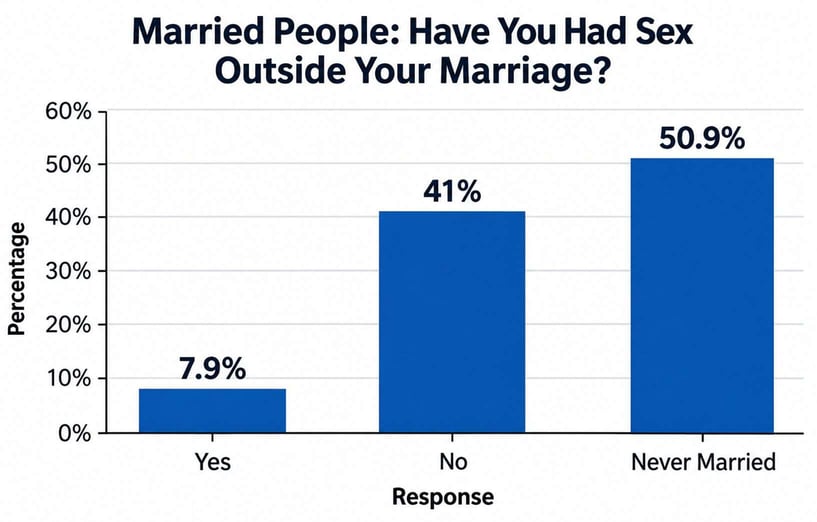
Well, not to be a downer, but these numbers don’t account for the respondents who have cheated without being married, or for the millions of Americans who weren’t surveyed at all. And as cynical as this sounds, we must also acknowledge that people who cheat on their partners might not always tell the truth, even in anonymous surveys.
5. A Resounding 90% Said Any Kind of Affair (Sexual or Emotional) is Morally Wrong
These respondents were, by far, the most in agreement about infidelity being morally wrong than they were about any other issue in the survey5. When asked about any other issue, respondents were split. For example, at 52%, respondents to this survey were second most likely to agree that viewing pornography was morally wrong.
Interestingly, people are much more likely to say that getting a divorce is a morally acceptable (76%) alternative to infidelity. I can’t help but wonder why people choose to cheat on their partner when they can just divorce their partner, something most respondents said was a perfectly acceptable, and even moral, option?
6. Economically Dependent Men Are More Likely to Cheat
Data collected between 2001-2011 shows that men who are economically dependent on their female partners are more likely to cheat than women in the same financial position6. This doesn’t mean men with financial control are less likely to cheat, however.
The same data found that men who provide 70% of a household’s income are also more likely to cheat than women in the same position.

This stat stands out for two reasons: A) Because it highlights how some men will cheat whether they’re the breadwinner or not, and B) Because it clearly suggests that men are more likely than women to cheat, regardless of their financial standing.
However, keep in mind that these stats consider two extremes. Many couples live in a dual-income household where the financial contribution ratio is more balanced.
And these more balanced households do, in fact, correlate with a decreased likelihood of infidelity. The data show that men who provide between 0% and 70% of the household income are generally less likely to cheat than women in the same financial position.
7. About 18% of Surveyed Adults Say Their Infidelity Was Emotional Rather Than Physical
Stereotypical depictions of infidelity usually emphasize sexual betrayal — you know, lipstick on the collar, and all that — and there’s obviously some truth to this: 17% of respondents to one survey said that their own personal infidelity was entirely physical in nature7.
But as it turns out, you shouldn’t overlook the emotional side of infidelity.
Eighteen percent of respondents said that their personal infidelity was largely emotional rather than physical.
Of course, real life is messy, and it’s not unusual for infidelity to blend both sexual betrayal and emotional betrayal. This is the case for 12% of the survey’s respondents.
8. Most Surveyed Adults Believe a Sexual Affair is Worse Than an Emotional Affair
Infidelity is always painful, regardless of the form it takes. But 40% of respondents to one survey agreed that a sexual affair is worse than an emotional affair (25%)7. Specifically, these adults say it’s worse to have a sexual affair without an emotional connection than to have an emotional affair without sex.
Which Type of Affair is Worse?
This might come as a surprise, considering how an emotional affair generally points to deeper relationship rifts than a sexual affair. But you just can’t deny the straightforward drama that accompanies sexual betrayal.
It might be easier for people to recover from cheating when they know their partner controlled their sexual urges, even if they still shared an emotional and even romantic bond with someone who wasn’t their partner.
9. Men are More Likely Than Women to Say a Sexual Affair is Worse Than an Emotional Affair
Pop culture and gossip will have you believe that men are sexually-motivated creatures, even more so than women. This might explain why nearly half (46%) of surveyed men say it’s worse to have a sexual affair that doesn’t involve feelings than an emotional affair that doesn’t involve sex (20%)7.
And yet, women seem to agree that sex can sometimes take precedence over emotion. Case in point: 35% of surveyed women agree that a sexual affair without feelings is worse than an emotional affair without sex, compared to the 30% of female respondents who said that an emotional affair without sex is worse.
10. Over 40% of Surveyed Adults Say It’s Never Reasonable to Take Back a Cheating Ex
For many people, cheating is the ultimate relationship-ender, a clear and unequivocal sign that something is broken that can’t be fixed. In this vein, 41% of respondents to one survey said it’s never okay to take back your cheating spouse7.
And yet, 37% of surveyed adults say there are circumstances that make it acceptable to take back a cheating partner.
What exactly these circumstances are is unique to every couple. Maybe the couple is decades into a relationship and wants to work it out. Maybe both people are victims of infidelity in their relationship. And maybe the person who was cheated on doesn’t actually consider infidelity to be a dealbreaker.
11. Baby Boomers are More Likely to Take Back a Cheating Partner Than Gen Z
The generations are largely divided on whether it’s ever reasonable to take back a cheating partner, with boomers allowing for more wiggle room than Gen Z. In fact, nearly half (47%) of surveyed adults over 60 said there are some circumstances that make it reasonable to take back a partner who cheated, while only 22% of adults aged 18-29 agree7.
Does this mean that baby boomers are more likely to put up with a cheating spouse than Gen Z? Not necessarily.
But it does suggest that older adults — those who have been in longer relationships, experienced the highs and lows of marriage, and gone through the dreaded mid-life crisis — are better able to see the nuance behind infidelity than younger adults.
12. A Majority of Respondents (94%) Agree That Having Sex With a Non-Partner Constitutes Cheating
A majority of survey respondents (94%) agree that the definition of infidelity is surprisingly straightforward: Having sex with someone who is not your partner constitutes cheating7. And yet, survey respondents are split when it comes to labeling other behaviors as forms of infidelity.
Sure, 82% of respondents could agree that sending nudes to someone who isn’t your partner is a form of cheating. But a not-insignificant 11% said that this behavior, while far from harmless, is “not cheating.” Infidelity just isn’t as black-and-white as we often think it is.
13. Is Messaging or Meeting With an Ex Cheating? 69% Say Yes
Sending a secret “U up?” text to your ex is much different than, say, an obligatory “happy birthday” message. But the gray area between the two is apparent in one survey, where just 69% of respondents said that secretly messaging or meeting up with an ex is considered cheating7.
Nearly 0% of respondents agree that secretly messaging or meeting up with an ex is a form of cheating.
Keeping any kind of communication or interaction with your ex a secret from your current partner is bound to cause suspicion. And yet, the gray area is clear in this survey, where 22% of respondents said this behavior is “not harmless, but not cheating.”
14. Over Half (52%) of Respondents Say That a Deep Emotional Attachment to a Non-Spouse is a Form of Infidelity
For some people, having a deep emotional attachment to someone who isn’t your partner cuts deeper than a purely sexual relationship ever could: Just over half (52%) of respondents agree that these kinds of emotional connections are a form of cheating7.
A smaller, but still significant, number of respondents — 32% — say that an extramarital emotional attachment is far from harmless, but doesn’t strictly constitute cheating, either. Only 5% say this behavior is harmless.
15. Engaging With Online Sex Workers/OnlyFans Creators Counts as Cheating to 47% of Respondents
If a sexual interaction does not involve direct sexual contact, does it count as cheating? The answer is yes, according to 47% of one survey’s respondents7. This cohort agreed that engaging with online sex workers and/or OnlyFans creators is a form of infidelity.

With nearly half of respondents on the same page, it’s clear that a secret OnlyFans subscription really can be as destructive as direct infidelity. And even if some respondents don’t count this as cheating, at least 33% still agree that it’s far from harmless.
16. Approximately 41% Say Romantic/Sexual Conversations With an AI Chatbot or Virtual Companion Doesn’t Count as Cheating
AI is still so new that we haven’t yet decided where the line between “innocent” and “guilty” actually falls. After all, some of us can barely wrap our heads around what an AI chatbot even is, let alone understand how some people could fall in love with one.
This explains why 41% of one survey’s respondents say that romantic or even sexual conversations with an AI chatbot or virtual connection don’t count as cheating, while 30% say it does count as cheating7.
If the person on the other end of those sexts isn’t a person at all, can you really say that anyone has crossed a line? It’s up to each couple to decide for themselves.
17. Some People Don’t See Flirting as a Form of Cheating, But They Also Don’t Think it’s Harmless
Unlike AI, flirting is the oldest (and most divisive) relationship boundary-pusher in the book. We know it’s divisive because one survey’s respondents were completely split as to whether flirting counts as cheating: 50% agreed that flirting with someone who isn’t your partner is not a form of cheating7.
26% of respondents said that flirting is a form of cheating.
Even 17% of respondents went so far as to say that extramarital flirting is completely harmless. Then again, 26% of respondents said that flirting is a form of cheating. The only thing we know for sure is that flirting can mean many different things to many different people, depending on their relationship histories and personalities.
18. About 2 in 3 Say Dancing With Someone is Not a Form of Cheating
There’s one type of behavior that many survey respondents agree is not actually a form of cheating, despite how it involves close physical interactions and even emotional engagement: Dancing8.
Sixty-six percent of 2,000 respondents to a Talker Research survey said that dancing with someone else is not a form of cheating and is even “fair game.”
After all, this survey doesn’t differentiate between an intimate slow dance and a tipsy rendition of the Electric Slide, so it’s possible that these respondents simply consider most forms of dancing to be unromantic and fun, not emotional and sexual.
19. Nearly Half (49%) of Respondents Would Confront Their Partner Over Keeping Pics of Their Ex
If you found your partner’s ex all over their camera roll or even on their social media, would you confront them about it? Perhaps naturally, nearly half (49%) of respondents to Talker’s study said that they probably would8.
Would You Confront Your Partner If They Texted Their Ex?
Source: Talker Research
Things only get worse for a cheater when you consider how even more people look suspiciously upon sketchy texts. Case in point: 62% of survey respondents would confront their partner if they discovered texts from an ex.
20. 37% of Respondents Would Confront a Partner for Not Sharing Their Phone Password
Technology has made it more complicated than ever to be fully honest with a partner. We’re all entitled to our own technological privacy in the form of our phones, right? Not everyone thinks so. Some of Talker’s survey respondents (37%) said they would confront a partner for not sharing their phone password with them8.
These respondents are so suspicious of their partner’s faithfulness that they’re willing to confront them over it. This says a lot about how little we actually trust each other in this modern technological world.
21. Over Half Agree Chatting With an Ex Can Make or Break a Relationship
If we can agree on anything other than the dangers of extramarital sex, it’s this: Chatting with an ex can break a relationship, says 60% of Talker’s respondents8.
Still, a non-insignificant 30% of respondents said being friends with an ex is not in and of itself suspicious or a dealbreaker… but that they would keep an eye on the friendship anyway.
Even if a relationship is fully platonic, many daters would still look out for signs of funny business.
22. One-Third of Sampled TV Shows Depict or Discuss Infidelity
Infidelity has been a hot topic for decades, and not just because it usually has personal, long-reaching effects. With one-third of sampled TV shows depicting or discussing infidelity in some way, it’s clear that the topic fascinates most of us, including single people9.
Cheating storylines are a go-to for a reason: They’re almost always as relatable as they are riveting. This statistic matters because it reveals how the media can shape our perception of cheating.
23. Ashley Madison Once Had Nearly 400,000 New Monthly Signups
Modern infidelity doesn’t only happen behind closed motel room doors, but on sites like Ashley Madison. And people still respond to Ashley Madison’s reputation for facilitating anonymous connections: In 2021, Ashley Madison claimed it logged nearly 400,000 new monthly sign-ups10.
Ashley Madison reportedly boasts 0 million members and counting.
The affair website may have recently broadened its demographic to include ENM relationships, but discreet arrangements are still its bread and butter. With reportedly 91 million members to speak of, Ashley Madison’s reputation as a go-to destination for affairs, secret sex, and kinky connections hasn’t faltered over the years11.
24. Those Who Scored Higher on Social Media Addiction Also Scored Highly on Social Media-Related Infidelity
One study found a correlation between social media addiction and social media-related infidelity12. We’re not talking about people who absent-mindedly scroll through Instagram at the dentist, but about people who need social media to get through the day.
It seems they’re more likely to participate in social media-related infidelity, such as DMing an ex or chatting with Instagram models, than more casual users.
If you get a dopamine boost from interacting with people on social media, then it stands to reason that you’ll also get a dopamine boost from flirting or even being intimate with people on social media. This study determined just that, especially among younger participants.
25. Over 350 Million TikTok Posts Have Tags Related to Cheating
I knew infidelity was a hot topic, but I didn’t know it was this hot: people have tagged over 350 million TikTok posts with words related to cheating13. This doesn’t mean that every single post is truly about infidelity, but it does suggest that cheating and betrayal are as much a part of modern conversations as they've always been.
Young people are turning to social media, namely video-based apps like TikTok, to reach out for comfort and to vent about their own run-ins with infidelity.
These 350 million TikTok posts undoubtedly run the gamut. Some are drama-filled tell-alls about a loathsome ex, while others are deep discussions about the realities of infidelity. Regardless of the content, it’s clear that young people are turning to social media, namely video-based apps like TikTok, to reach out for comfort and to vent about their own run-ins with infidelity.
26. A Solid 40% of Married Couples Who Cheated Were Separated When Surveyed
The potential consequences of infidelity are clear to see in this particular survey’s data, which centers on data collected over a 6-year period14. Only 17% of partners who have not cheated were separated or divorced by the time they were surveyed, compared to 40% of those who had cheated.
We can’t possibly know each respondent’s personal infidelity experience, but it’s safe to say that infidelity played some kind of role in their eventual marital breakdowns. Regardless of the work each person puts into relationship recovery, it isn’t easy to come back from cheating.
27. Are Men More Likely To Cheat? It Depends on Their Age
Despite stereotypes to the contrary, women aged 18-29 are slightly more likely to cheat than men in the same age group (11% vs 10%)14. But age, it seems, can change this completely. As it turns out, infidelity is not solely a young man’s game. The older we get, the more likely men are to cheat than women.
Are Men or Women More Likely to Cheat?
Source: General Social Survey
- Men
- Women
Women’s rate of infidelity drops in their 70s and 80s, but men in their 70s report the highest rate of infidelity (26%), according to this particular study. This number only drops two points to 24% as men age into their 80s, a staggering difference to women of the same age (6%).
28. There’s a Connection Between High-Status Professionals and a Higher Infidelity Rate
There’s actually some truth to the phrase “more money, more problems.” Or, more accurately, “more money, more access.” This 2011 survey of 1,561 professionals found that people who have more authoritative, and therefore high-paying, roles at work tend to commit infidelity more than those who don’t15.
After all, money has the power to expand your social network both online and off. And when you have a high-powered career, your social and financial freedom can lead to something even more important: A confidence boost.
This survey suggests that increased confidence leads to higher rates of infidelity. Interestingly, this particular survey finds this correlation only in male respondents, not female respondents.
29. Only One-Third of Study Participants Confessed Their Infidelity
Much of the drama we associate with infidelity comes from the fallout, which obviously includes when the cheated-on party discovers the infidelity. But one 2020 investigation into 495 self-described cheaters revealed that very few — just one-third of respondents — actually come clean to their partners16.
And when they do come clean, it isn’t always because they feel guilty, but because they want to inflict emotional harm.
The startling reality of infidelity is that the act of cheating itself isn’t always the goal — the betrayal is. This study found that some people cheat solely out of anger. And they don’t confess to ease their conscience or to wipe the slate clean, but so they can exact revenge on their partner.
30. We’re Less Likely to Cheat Now Than in the ‘90s
When Ross insisted that he and Rachel were “ON A BREAK!!!” when he slept with someone else, it divided a nation. Was he truly unfaithful? This question and others about infidelity were on everyone’s mind in the ‘90s, perhaps because we were apparently more likely to cheat back then than we are now.
One survey tracked how attitudes about cheating have changed since the ‘90s, and the results revealed a generation reckoning with the nature of betrayal16. Between 1991-1998, 17% of prime-age adults admitted that they’d had sex with someone other than their spouse. But between 2010-2018, this number fell to 14%.

This slow decline continued its descent to 13% between 2021 and 2022. According to this survey, some people may still consider cheating, but are increasingly less likely to actually cheat. Maybe Ross and Rachel’s dilemma turned people off to cheating once and for all.
It’s More Acceptable Than Ever To Form Our Own Definitions of Infidelity
Remember that red lipstick I mentioned earlier? There was a time when it symbolized a wife’s worst nightmare — her husband’s deceit — and kicked off a marriage’s downfall. But this straightforward reaction doesn’t really exist anymore.
Modern couples are increasingly willing to question society’s relationship rules and decide for themselves what crosses the line. In other words, someone else’s red lipstick doesn't necessarily have to be a dealbreaker.
These statistics reflect that shift. Sure, sex outside of marriage is still widely considered a no-go. But there's far less consensus when it comes to flirting with strangers, messaging an ex, or getting freaky with a chatbot.
What one person considers unacceptable might be perfectly fine with someone else. Rather than subscribing to a universal set of relationship rules, today's couples seem more comfortable figuring out what works for them.
Data Sources:
- https://www.americansurveycenter.org/newsletter/is-america-experiencing-an-infidelity-epidemic/
- https://gssdataexplorer.norc.org/variables/633/vshow
- https://www.psychologytoday.com/us/blog/better-divorce/202202/is-marriage-doomed-after-affair
- https://gss.norc.org/content/dam/gss/get-documentation/pdf/codebook/GSS%202022%20Codebook.pdf?utm_source=chatgpt.com
- https://www.pewresearch.org/religion/2026/03/19/what-do-americans-consider-immoral/
- https://www.asanet.org/people-more-likely-cheat-they-become-more-economically-dependent-their-spouses/
- https://yougov.com/en-gb/articles/55371-section-4-cheating-in-relationships
- https://talkerresearch.com/fair-game-or-cheating-these-bedroom-boundaries-are-up-for-debate/
- https://www.researchgate.net/publication/360004381_Prime_Time_Affairs_A_Quantitative_Analysis_of_Infidelity_in_Popular_Television_Programs
- https://www.ashleymadison.com/2021report
- https://www.ashleymadison.com/en-us/
- https://www.psychologytoday.com/us/blog/love-digitally/202407/the-link-between-social-media-interaction-and-infidelity
- https://cheatscanx.com/blog/social-media-cheating-statistics/
- https://ifstudies.org/blog/who-cheats-more-the-demographics-of-cheating-in-america
- https://journals.sagepub.com/doi/10.1177/0956797611416252
- https://www.tandfonline.com/doi/full/10.1080/0092623X.2020.1856987