


Dating can sometimes feel like a cold game. You swipe past hundreds of people on dating apps, message dozens, and try to find someone you maybe, just maybe, connect with on the real stuff. And then, just when you think things are finally going well, that person stops responding.
Most daters are all too familiar with ghosting, but it still hurts. Ghosting – which involves one party cutting contact with another out of the blue, thus disappearing like a ghost — has become an increasingly large issue, especially in the online dating scene.
Ghosting is an unavoidable trend in today’s dating scene. It’s worth learning about who ghosters are, why they do it, and what the effects are on those who find themselves ghosted.
1. About 3 in 4 Active Daters Have Been Ghosted
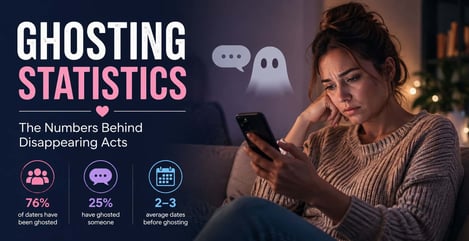
Ghosting is exceedingly common. If you’re actively dating, chances are, it’s happened to you. According to Forbes, 76% of daters report having been ghosted by someone they’re dating1. Unfortunately, it’s just an expected part of dating now.
Of course, what ghosting looks like varies dramatically person by person. Some people consider it ghosting if someone stops responding out of the blue on a dating app, while others don’t consider it ghosting until you’ve met in person.
2. Nearly Half of Daters Admit to Ghosting Someone
The flip side of so many people experiencing ghosting is that many people have ghosted others themselves. As much as 45% of daters admit to having ghosted someone2. And given that the polling was based on self-reporting, we can only expect that the real number is higher.
Because so many people have ghosted on dates, surely we can’t write off everyone who ghosts as horrible people. While ghosting itself might be unkind, the reasons ghosters do it are varied and come in different shades of moral grays.
3. Women Are 3% More Likely Than Men to Ghost Someone
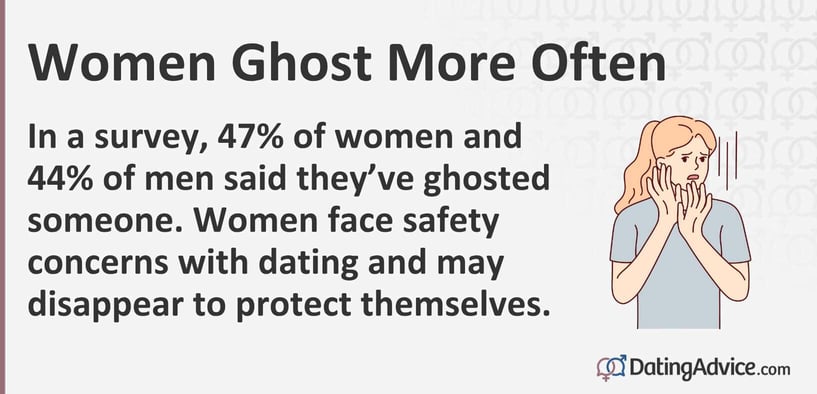
While both men and women ghost, women are slightly more likely to do a disappearing act. A recent survey found that 44% of men admit to ghosting, while 47% of women admit to the same3.
Some may be quick to blame this difference on the cruelty of women or the ease of dating for them (Ha!). But in reality, more women experience emotional and physical danger while dating and may see ghosting as the safest way to get out of a questionable situation.
When I used dating apps, I encountered several men who were getting aggressive in messages and making rude comments if I took too long to respond. Some said things that made me a bit uncomfortable like the guy who asked if I lived alone.
In such instances where my personal safety seemed at risk, I found the best course of action was to stop responding, and I know many women take a similar route.
4. Of Men, 64% Have Been Ghosted
Just as men are slightly less likely to ghost, they’re also a bit more likely than women to have been ghosted, with 64% of men reporting that they’d experienced ghosting at some point4.
It’s worth noting that men are also online dating at higher rates than women, so they’re more likely to be ghosted for that reason as well as the safety concerns of women already discussed.
On the other hand, men are more likely than women to ghost someone after sleeping with them (25% to 20%), so it seems like the when and why of ghosting is notably different for men and women.
5. With 77% of Gen Z Admitting to Ghosting, It’s Most Common Among Younger Daters
Younger daters are far more likely to ghost, with 77% of Gen Z having admitted to ghosting someone, compared to just 61% of millennials5.
Online dating makes it far easier to ghost someone.
In some ways, this might have more to do with the increased popularity of online dating rather than anything else. Online dating makes it far easier to ghost someone. You’re often messaging someone without ever meeting them (which is likely a more acceptable time to ghost someone than after you’ve actually gone out).
It’s also possible that Gen Z sees ghosting as a more acceptable course of action. Their behavior could be a general indicator that Gen Z needs less of an explanation for why someone stopped seeing them or thinks that they don’t owe an explanation.
6. An Overwhelming 84% of Millennials & Gen Zers Have Been Ghosted
Though Gen Z daters might be more comfortable ghosting, Gen Z and millennials are equally vulnerable to being left on read, with 84% reporting that they have been ghosted6.
Unfortunately, getting ghosted may just be an expected part of the dating experience now for young people.
7. Just 14% of Daters Over 65 Have Been Ghosted
While younger daters have to deal with ghosting, far fewer older adults have had the same misfortune. Just 14% of adults over 65 report having been ghosted7.
Of course, fewer adults over 65 have experienced dating since the dawn of dating apps. But it’s also possible that even for those who have, the idea of completely cutting contact with a date is seen as more disrespectful and doesn’t align with the same IRL dating etiquette they grew up with.
8. Surprisingly, 3 in 4 Daters Think Ghosting Can Be Appropriate
Many people see valid reasons that someone might choose to ghost a person they’re dating or talking to online. Thrive Center of Psych found that 3 out of 4 daters think that in some instances, ghosting is the appropriate course of action8.
Can Ghosting Be Appropriate?
Sometimes, ghosting is the best way to preserve your privacy or personal safety. But even in tamer instances, many people believe ghosting is acceptable if you haven’t met an online match yet in person or if you “mutually ghost” each other, in which neither party initiates further contact. Both parties might be on the same page that it isn’t going to work out.
9. A Resounding 9 Out of 10 Women Feel Relief After Ghosting
Getting ghosted might hurt your feelings, but for many ghosters, the experience gives them a sense of relief. A resounding 91% of women report feeling relieved after ghosting someone, and 80% of men say the same9.
It makes a lot of sense that ghosting would be a freeing experience. Being involved with someone you’re no longer interested in can take a lot of emotional energy, and it may even make you feel guilty for not disclosing your misgivings about the connection.
Ghosting allows you to stop putting work into the relationship, and it frees you from having a hard conversation. The only problem is the hurt it gives the person you ghosted.
10. At 93% of Daters, Rhode Island Has the Highest Rate of Ghosting
The frequency of ghosting actually varies a lot by state. A study found that daters in Rhode Island were the most likely to either ghost someone or have been ghosted at some point, with 93% of Rhode Island daters having experienced it10.
On the flip side, Oregon daters were the least likely to ghost or be ghosted.
Dating culture changes depending on where you are, so if you’re struggling with dating on the East Coast, maybe heading out to the Pacific Northwest is right for you!
11. Sadly, 1 in 10 Daters Have Been Ghosted After Months of Dating
Different people have varying opinions on the ethics of ghosting at different points in the talking stage. But it’s near impossible to defend ghosting someone after you’re in a committed relationship with. Still, it happens.
One in 10 people who have been ghosted say it happened months into a relationship11.
after months of dating.
Getting ghosted by a long-term partner can be incredibly destabilizing. It makes you question how they felt about you the entire time, and it can feel like a brutal loss.
Ghosting is seldom a good move, but in a long-term relationship, it’s completely unacceptable.
12. At 18.5%, the Most Popular Reason for Ghosting Is Convenience
Ghosting may seem careless, but according to a study by East Carolina University, most ghosters actually did have a clear sense of why they did it.
For 18.5% of survey participants, their reasoning was simple: Ghosting is easier than ending a relationship directly12.
A formal breakup requires arranging to meet up with your soon-to-be-ex, or engaging in a tough conversation you’d probably rather not have. Ghosting requires zero action and zero accountability.
13. When Confronted About Ghosting, 1 in 5 Felt No Remorse
Not all ghosters feel bad about it. When asked what message they would like to send to someone they’d ghosted, about one in five ghosters had a nonapologetic message, saying that they did not regret their decision to ghost the person13.
While ghosters are not representative of the general population, this does suggest that some people stand by ghosting as a decision that might be valid depending on the circumstances.
14. Of Those Ghosted, 42% Wanted an Explanation
The same East Carolina University study found that 42% of people who had been ghosted — the highest percentage — wanted an explanation of why they were ghosted14.
Everyone experiences rejection, and you can’t hold it against someone if they reject you. Most people understand that. What bothers them is the uncertainty of being ignored with no reasoning. Clarity would help them move on from the relationship with closure.
15. On Dating Apps, 1 in 3 Rejections Involves Ghosting
People who meet in person certainly ghost each other sometimes, but the most significant portion of ghosting occurs when relationships start online. One in 3 rejections on a dating app occur through ghosting15.
While that may be viewed as socially acceptable for matches who’ve never met in person, it can create a pattern of behavior that becomes increasingly hurtful the more you get to know a person.
Still, it’s hard to know the right way to go about rejecting someone online. Do you owe someone an explanation if you match but don’t want to have a conversation? How about if you’ve just exchanged a few messages? Different people have different answers, but the etiquette is certainly changing as online dating becomes more prevalent.
16. After Being Ghosted, 1 in 3 Internalize Blame
Some people get angry after getting ghosted, but more still blame themselves. A reported 37% of people who have been ghosted blame themselves16.
People can overthink and worry that they were ghosted because:
- They said something weird or wrong.
- They offended the person.
- They're unattractive.
- They came on too strong.
It’s so easy to spiral and come up with what-ifs. But the truth is that we may never know what prompted the ghosting, and it's time to move on regardless. It’s entirely possible it had nothing to do with anything you said or did. The feelings just weren’t there.
17. About Half of Ghosters Experience Guilt or Remorse
Some ghosters feel bad for hurting the people they date. Aabout half of ghosters said they felt guilt or remorse after ghosting someone17.
But not guilty enough to apologize and have that breakup conversation.
Feeling guilt about ghosting may not change a ghoster’s behavior going forward, but I guess it’s nice that people have some sort of conscience.
Ghosting Is Common, But That Doesn’t Make It Right
Online dating isn’t going anywhere, and ghosting probably isn’t either. Daters are often more comfortable cutting contact instead of having hard conversations.
When both parties feel that the relationship isn’t going anywhere, mutual ghosting can feel seamless. But if someone gets blindsided by ghosting, it’s extremely hurtful and confusing.
Do the right thing and resist the urge to ghost when you can. A quick, kind, and clear message can go a long way.
- https://www.forbes.com/health/mind/modern-dating-mental-health/ ↩︎
- https://www.forbes.com/health/mind/modern-dating-mental-health/ ↩︎
- https://www.forbes.com/health/mind/modern-dating-mental-health/ ↩︎
- https://www.forbes.com/health/mind/modern-dating-mental-health/ ↩︎
- https://thrivingcenterofpsych.com/blog/gen-z-millennial-ghosting-statistics/ ↩︎
- https://thrivingcenterofpsych.com/blog/gen-z-millennial-ghosting-statistics/ ↩︎
- https://www.pewresearch.org/social-trends/2020/08/20/personal-experiences-and-attitudes-of-daters/ ↩︎
- https://thrivingcenterofpsych.com/blog/gen-z-millennial-ghosting-statistics/ ↩︎
- https://thrivingcenterofpsych.com/blog/gen-z-millennial-ghosting-statistics/ ↩︎
- https://www.forbes.com/health/mind/modern-dating-mental-health/ ↩︎
- https://thrivingcenterofpsych.com/blog/gen-z-millennial-ghosting-statistics/ ↩︎
- https://sociology.ecu.edu/wp-content/pv-uploads/sites/245/2019/12/Poster-Final-for-SSS-Ghosting.pdf ↩︎
- https://sociology.ecu.edu/wp-content/pv-uploads/sites/245/2019/12/Poster-Final-for-SSS-Ghosting.pdf ↩︎
- https://sociology.ecu.edu/wp-content/pv-uploads/sites/245/2019/12/Poster-Final-for-SSS-Ghosting.pdf ↩︎
- https://www.medicalnewstoday.com/articles/ghosting#reasons ↩︎
- https://www.medicalnewstoday.com/articles/ghosting#reasons ↩︎
- https://www.psychologytoday.com/us/blog/some-assembly-required/202208/the-mental-health-effects-of-ghosting ↩︎